Florida Engineering needed a clearer route from “I have an engineering problem” to the right service and a quote request. When Local Legacy took over the website about three years ago, more than 50 service pages were missing and the branding needed to better reflect the company's capabilities. The assignment started with those customer-journey gaps.
Our two central changes were to build out the service structure and improve the path from service information to an inquiry. Brand improvements, a consistent article schedule, and schema markup supported that work. This case study explains the decisions behind the website, using our firsthand project experience and the finished site shown in our Port Charlotte portfolio.
The original problem: expertise without a clear customer path
A business can offer a service without explaining it well on its website. That was a major gap when we began: Florida Engineering's service offering was broader than the site's dedicated service content. More than 50 service pages were missing, and visitors were not clearly guided toward the right service and a quote request.
That matters for technical services. A prospective customer may recognize the problem they need solved without knowing how the engineering firm organizes its work. A broad statement about capability leaves the visitor to work out whether the company can help and whom to contact.
We also needed the branding to feel consistent with the company's capabilities. Visual presentation and service communication had to work together. Improving only the homepage's appearance would have left the missing service explanations unresolved.
First change: make the service structure useful
We built dedicated service pages that explained what Florida Engineering offered and gave customers a clearer path toward the right team. The purpose was to make the offering understandable at the point where a visitor needed to choose a service.
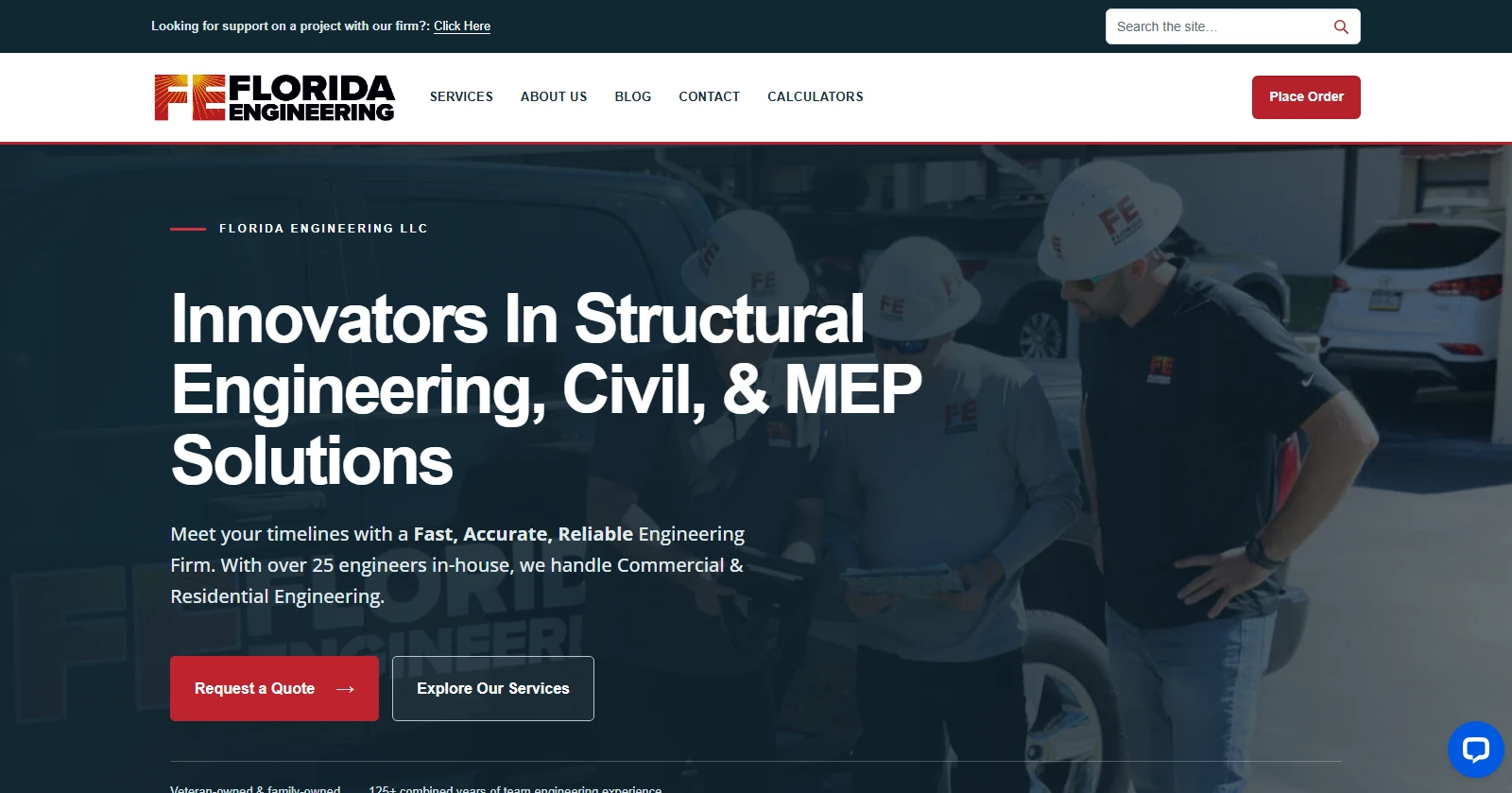
The retained homepage screenshot shows structural, civil, and MEP engineering presented as recognizable service categories. Those categories give the visitor a starting point; the dedicated pages then have the job of explaining the relevant service in more detail.
For another professional-service business, this distinction helps decide what deserves a page. Separate pages are useful when customers have different problems, need different explanations, or should reach different parts of the business. A page count by itself does not establish a good structure.
Here is the planning framework we would use to assess that structure:
| Customer question | Website responsibility | Review test |
|---|---|---|
| Can this company help with my problem? | Introduce recognizable service categories | Can someone unfamiliar with the business choose a useful starting point? |
| Is this the service I need? | Explain the individual service clearly | Does the page answer the questions needed before an inquiry? |
| How do I discuss my project? | Connect the explanation with a relevant quote path | Can the visitor act without searching for contact instructions? |
| Where do I go about work already underway? | Make existing-customer support visible | Can a returning customer find help without treating it as a new sale? |
This is a review framework, not a claim that every visitor follows the same sequence. People may enter on an individual service page, so the next step needs to make sense there as well as on the homepage.
Second change: connect service information to a quote request
We improved the route from the service pages to an inquiry so a prospective customer could move from understanding the service to asking about their project more naturally. The service explanation and the contact action needed to feel connected.
On the homepage shown here, “Explore Our Services” and “Request a Quote” provide two different next steps. Someone still evaluating the company can investigate the offering. Someone ready to discuss work can move toward a quote request.
The useful lesson is to place the action at a decision point. After reading a service page, a visitor should understand what the company does and what to do next. A generic contact button is less useful if the surrounding page has not established whether the service fits.
For your own site, try that path from a phone: enter through a service page, read enough to decide whether to inquire, and follow the action. Then check that the request reaches the responsible person. Our contractor inquiry guide applies the same principle to qualifying project requests.
Keep existing-project support visible
The finished homepage also has a header route for people seeking support on a project already with the firm. That is visible in the portfolio screenshot. It serves a different customer task from a new quote request.
A returning customer may be looking for help with current work, while a prospect is deciding whether to hire the company. Giving each task a recognizable route can make the site easier to navigate. When planning your own site, identify those different needs before deciding which actions belong in the header.
Branding, publishing, and search foundations
Alongside the service and inquiry work, we strengthened the branding, established a consistent article-publishing schedule, and added schema markup to help search engines understand the site.
Schema describes information in a structured form. Google's introduction to structured data explains how it helps Google understand page content. It complements the information people can read; it does not replace useful service pages or establish a ranking guarantee.
The relationship continued beyond the initial website work. Our wider work includes the sister-company websites Gunderson Engineering and Lightning Engineering. This account focuses on the Florida Engineering project and the decisions described above.
What another Port Charlotte business can take from this project
The practical result of this work was a more complete service structure and a clearer route to requesting a quote, supported by a more consistent brand presentation and ongoing content work. Those are changes to the website and its operation; they are not a measured claim about revenue or search growth.
A smaller business does not need to copy the number of service pages. It can apply the same order of decisions:
- Identify the customer problems your business actually solves.
- Check which of those services the site explains adequately.
- Give each important service a clear path to the appropriate inquiry.
- Keep support for existing customers easy to find when that is a separate task.
- Assign responsibility for keeping the content accurate after launch.
Our Port Charlotte website-design work and website-design service start with that business conversation. The design has a clearer purpose once the customer journey is understood.
Does every service need its own page?
No. Use a dedicated page when the service needs its own explanation and decision path. Closely related offers may be clearer together. Florida Engineering's missing service coverage was a specific project need, not a page-count target for every business.
Is this a one-time redesign or ongoing work?
Both website improvements and continuing work are part of the relationship. The service structure and quote path were central website changes; publishing and brand work continued beyond those changes. Define those responsibilities separately in your own proposal.
Discuss your service-business website. Bring the services customers struggle to understand and the action you want them to take. We can use those details to plan a more useful site.