Local SEO is often sold as a collection of switches: add a city to a page, fill out a profile, collect a few reviews, and wait for the phone to ring. Real local visibility is less dramatic and more durable. It comes from making the business accurate, understandable, credible, and easy to contact across the places customers search.
Google says local results are mainly shaped by relevance, distance, and prominence. A business can improve the clarity and completeness of its information and build real-world prominence, but it cannot change every searcher’s distance or buy a better organic local position from Google.
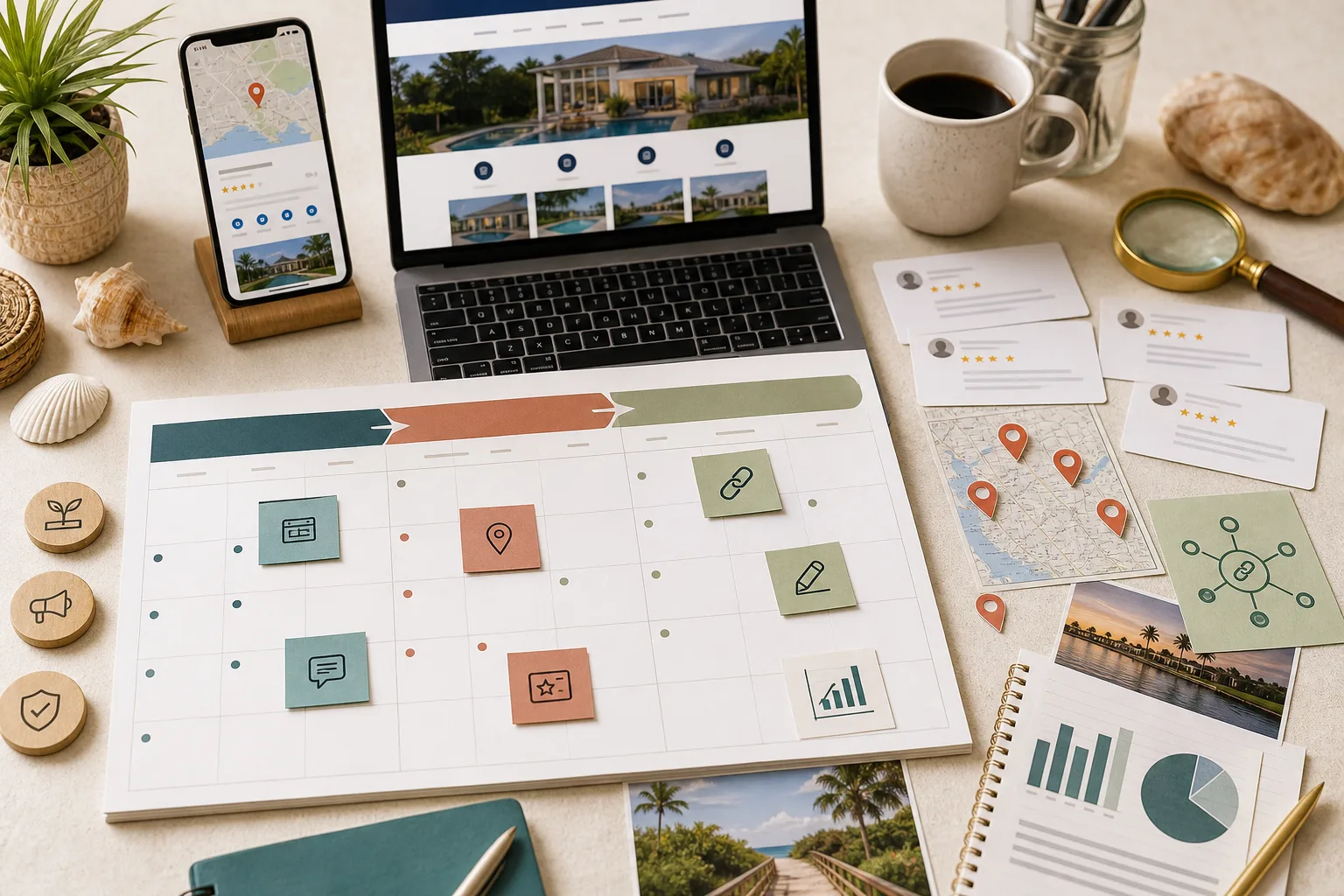
This 90-day plan gives Southwest Florida service businesses a practical sequence. It does not promise a specific ranking. It builds a foundation that can be measured and improved.
Before day one: choose a measurable goal
“Rank number one” is not a complete business goal. Rankings vary by searcher, location, wording, device, and result type. Choose outcomes connected to the customer journey:
- Qualified calls or form submissions
- Booked estimates or appointments
- Requests for directions, when relevant
- Visibility for specific profitable services
- Growth in non-branded discovery
- Better conversion from profile and website visits
Record a baseline before making major changes. Save current profile performance, analytics, form counts, call records, important search queries, and the pages customers land on. If tracking is incomplete, fixing it belongs in the first month.
Days 1–30: build an accurate foundation
Week 1: audit the business entity
Create one approved record for the business’s real-world information:
- Legal and customer-facing name
- Address or service-area configuration
- Primary phone number
- Regular and special hours
- Primary and secondary categories
- Services actually offered
- Website and appointment links
- Business description
- Logo and current photographs
Compare that record with the website, Google Business Profile, major directories, social profiles, and industry listings. Correct genuine inconsistencies. Do not add keywords to the business name unless they are part of the real-world name.
For a detailed profile review, use our Google Business Profile optimization checklist rather than duplicating every profile field here.
Week 2: map services to real pages
List the services customers search for and identify the best page for each one. A page should have a clear job. If several important services are compressed into one vague paragraph, create a plan for useful, distinct service pages.
Each service page should explain:
- Who the service is for
- The problem it solves
- What is included
- How the process works
- Relevant proof or qualifications
- Frequently asked questions
- The next step
Avoid publishing dozens of nearly identical city pages. A location page should exist because the business has meaningful information for that market—not because a city name can be swapped into a template.
Week 3: fix the customer path
Local visibility has limited value if a visitor cannot act. Test the website and profile from a phone. Confirm calls, forms, scheduling, directions, and payment actions work.
Strengthen the pages that receive local traffic:
- Put the service and customer fit near the top.
- Use a clear primary call to action.
- Make phone numbers tappable.
- Keep forms proportionate to the request.
- Show relevant trust signals without clutter.
- Explain service areas accurately.
- Improve speed and readability on mobile devices.
Week 4: establish measurement
Configure appropriate analytics and search tools. Track the actions the business can responsibly measure. Use consistent campaign parameters where useful and document how phone calls and form leads are classified.
Create a simple monthly scorecard:
- Qualified leads by source
- Profile interactions
- Organic landing pages
- Search queries and impressions
- Conversion rate for important pages
- Review count and response status
- Technical or content issues discovered
Do not let a single vanity metric become the entire strategy.
Days 31–60: improve relevance and customer proof
Week 5: strengthen the highest-value service page
Choose one page tied to an important service and improve it substantially. Add original explanations, useful examples, accurate process details, owner questions, and stronger internal links. Do not expand content merely to reach a word count.
For businesses serving Fort Myers or Cape Coral, connect relevant service pages with the corresponding Fort Myers or Cape Coral page when the relationship helps the visitor.
Week 6: build a fair review process
Ask customers for honest feedback at a natural point after service. Make the request easy, do not offer incentives for positive reviews, and do not ask only customers expected to respond favorably.
Respond professionally to reviews. A useful response acknowledges the customer without exposing private details or repeating marketing language. Escalate sensitive issues through the proper customer-service process.
Week 7: publish one genuinely useful resource
Choose a question customers repeatedly ask before hiring. Answer it completely with first-hand business knowledge, clear limitations, and relevant sources.
Useful topics might include:
- How to compare estimates
- What to prepare before an appointment
- Maintenance timelines
- Permit or process questions that can be sourced accurately
- Warning signs that deserve professional attention
- What affects cost without pretending every project has one price
The article should help a real customer make a better decision even if they never hire the business.
Week 8: improve internal discovery
Connect the new or improved resource to the service page it supports. Link from service pages to relevant proof, FAQs, and location information. Use descriptive anchor text that tells the visitor where the link goes.
Fix broken links and identify pages with no meaningful internal links pointing to them. Avoid inserting exact-match keyword links repeatedly across the site.
Days 61–90: build local authority and refine
Week 9: document real local relationships
Look for legitimate organizations and relationships connected to the business: chambers, professional associations, suppliers, nonprofits, events, licensing bodies, and community partnerships.
Keep profiles accurate and complete. Seek links or mentions only where they make sense to a human reader. Do not buy bulk directory submissions or manufacture partnerships for SEO.
Week 10: improve visual proof
Add current, truthful images that help customers understand the business: team, equipment, process, completed work, storefront, service vehicles, or products. Obtain appropriate permission and avoid exposing private customer information.
Update weak website images and the Business Profile where appropriate. Descriptive filenames and alt text should explain the image for accessibility, not repeat a keyword list.
Week 11: inspect performance by page and service
Compare the 90-day period with the baseline while accounting for seasonality and business changes. Ask:
- Which pages gained relevant impressions?
- Which pages attract visits but few inquiries?
- Which services generate qualified leads?
- Are branded searches changing differently from non-branded discovery?
- Which profile actions changed?
- Did any rankings or conversions decline after a site change?
Small data sets need caution. A few leads can produce large percentage swings. Look for patterns and customer quality, not only totals.
Week 12: choose the next sprint
Turn findings into a short backlog. Prioritize work with a clear customer or operational benefit:
- Fix accuracy and technical problems.
- Improve pages already earning relevant visibility.
- Answer high-value customer questions.
- Strengthen proof and conversion paths.
- Expand into another service or location only when the business can support a distinct, useful page.

The first 90 days should create a repeatable system: establish the foundation, improve visibility, build authority, measure, and begin again.
What not to do
- Do not buy reviews or gate review requests.
- Do not add services or locations the business does not genuinely serve.
- Do not stuff keywords into the business name.
- Do not create thin city pages with interchangeable copy.
- Do not promise that a particular task will produce a particular ranking.
- Do not treat one grid-ranking screenshot as complete performance evidence.
- Do not change core business information repeatedly without a real reason.
- Do not publish automated content without fact-checking and meaningful original value.
Google explicitly says there is no way to request or pay for a better organic local ranking. The work is to improve the signals and customer experience the business can legitimately control.
Frequently asked questions
Can a service-area business rank in every Southwest Florida city?
There is no responsible guarantee. Distance is one of Google’s stated local factors, and visibility can vary by searcher. Focus on accurately representing real service areas and building useful, distinct information for markets the business genuinely serves.
How quickly does local SEO work?
Timelines vary with competition, history, proximity, website condition, reputation, and the work completed. Ninety days is a useful operating cycle, not a promise that rankings or leads will reach a specific level.
Should every service have its own page?
Only when the service has distinct customer intent and enough useful information to deserve a page. Closely related minor services may be clearer together.
Are reviews the most important local ranking factor?
Google describes local ranking through a combination of relevance, distance, and prominence. Reviews can contribute to prominence and customer choice, but no single element controls every local result.
Does local SEO replace advertising?
No. Organic local visibility, referrals, partnerships, email, social media, and advertising can support different stages of growth. Evaluate each channel by qualified business outcomes.
Build a system, not a collection of tricks
The strongest local SEO strategy is understandable enough to repeat: keep information accurate, explain services clearly, earn honest customer proof, participate in the real community, publish useful expertise, and measure what becomes a qualified lead.
Local Legacy Consulting’s Local Visibility service helps Southwest Florida businesses align their profiles, websites, content, and customer paths without relying on ranking guarantees or disposable tactics.