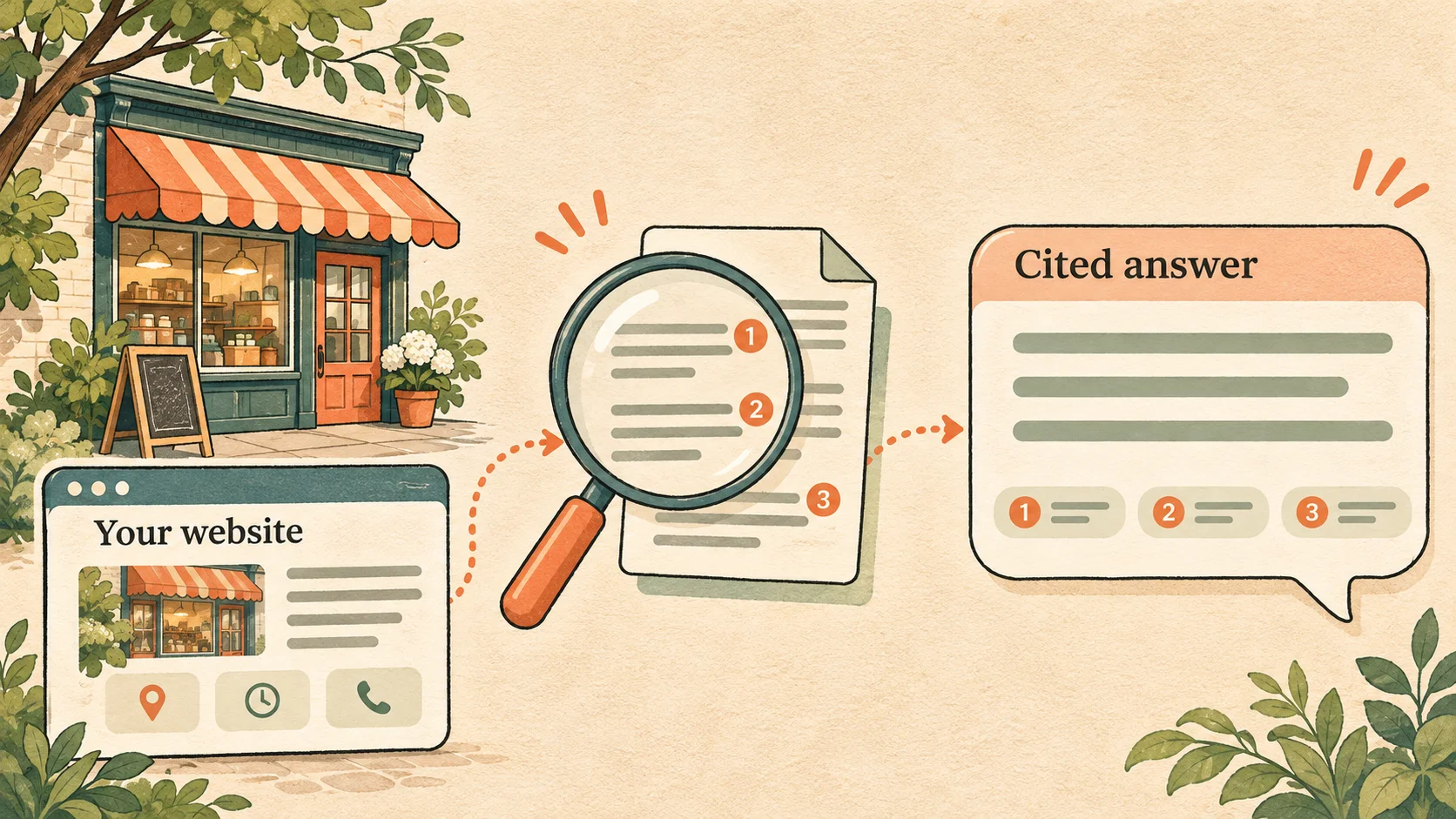
Getting your business cited in ChatGPT starts with accessible pages, clear answers, and information worth referencing. Generative Engine Optimization, or GEO, is the work of improving those conditions—and measuring whether your business actually appears in AI responses.
There is no guaranteed formula for becoming ChatGPT’s first recommendation. But there are practical improvements you can make without rebuilding your entire marketing strategy around another acronym.
Here is where to focus, what to measure, and which claims deserve a closer look.
What does “ranking in ChatGPT” actually mean?
In traditional search, ranking usually means a page’s position in a list of results. In ChatGPT, visibility can take several forms:
- Your business is mentioned in an answer.
- Your website is linked as a supporting source.
- Your business appears among recommended providers.
- Information about your business comes from another website.
These outcomes are different. A mention without a link is not a website citation, and a citation is not automatically an endorsement.
ChatGPT also does not search the web for every response. This guide focuses on visibility in answers that use web search, where current pages can be retrieved and cited.
OpenAI describes search selection in terms of relevance, reliability, and other factors; it does not publish a formula that guarantees placement. OpenAI’s ChatGPT search guidance.
If you are still sorting out the terminology, start with our guide to SEO, AEO, and GEO.
1. Make sure your website can be accessed
Before rewriting articles for AI, check whether search systems can reach your important pages.
A useful technical review covers:
- Pages that load successfully without a login.
- Important information available as readable text.
- Internal links that lead to your service pages and articles.
- A current sitemap containing the pages you want discovered.
- Security settings that do not accidentally block legitimate search crawlers.
For OpenAI specifically, three names are often confused:
| Agent | Purpose |
|---|---|
| OAI-SearchBot | Crawls for ChatGPT’s search features. |
| GPTBot | Crawls content that may be used for model training. |
| ChatGPT-User | Accesses pages for certain user-initiated actions. |
You can allow OAI-SearchBot while disallowing GPTBot. Making your site eligible for search does not require agreeing to training access.
OpenAI also says ChatGPT-User is not the control for search inclusion, and robots.txt rules may not apply to its user-initiated requests. Check both your crawler rules and your hosting or security service against OpenAI’s crawler documentation.
For your main content, making text available in the initial page HTML is a sensible compatibility measure. Avoid making essential service details depend entirely on scripts, clicks, or interactive widgets.
2. Keep traditional search indexing healthy
Bing Webmaster Tools is worth including in your website maintenance routine. Submit your sitemap, inspect important URLs, and investigate indexing errors.
Microsoft explains that sitemaps help systems discover and maintain current information, while submission does not guarantee visibility. Bing’s sitemap guidance.
Treat this as useful discovery work. A Bing submission is not a direct submission to ChatGPT, and a strong Bing ranking is not proof that ChatGPT will cite you.
Keep your Google search foundations healthy, too. AI visibility is another outcome to measure alongside the work you already do to help customers find your business.
3. Answer the customer’s question early
A page should make its purpose obvious.
If someone asks what a website redesign includes, give them a useful answer near the beginning. Then explain the details, options, and limitations.
For example:
A website redesign can include updated page layouts, clearer service descriptions, improved mobile usability, and better contact forms. The scope depends on whether the existing content, platform, and integrations still meet the business’s needs.
That answer gives readers something concrete immediately. The sections below can explain what changes the scope and what a business should prepare.
There is no established universal rule that an answer must contain exactly 40 to 60 words. Use enough space to answer accurately.
A practical page structure is:
- A direct answer.
- Supporting explanation.
- Examples or evidence.
- Important exceptions.
- A relevant next step.
Headings, lists, and comparison tables can make that structure easier to follow. Use them where they clarify the information; adding a table to every page is not a ranking strategy.
4. Give people something worth citing
Generic advice is easy to reproduce. Specific, documented experience gives readers a reason to reference your page.
For a local service business, useful material might include:
- A project case study explaining the problem, work completed, and measured outcome.
- A pricing explanation showing what changes the estimate.
- A comparison based on clearly stated criteria.
- Answers to questions customers repeatedly ask.
- Original observations with dates, sample sizes, and limitations.
A small, honest example can be more useful than a broad claim.
“Here is what we changed on this project and what happened afterward” gives readers something they can assess. “Our approach delivers exceptional results” does not.
Where you publish numbers, explain where they came from. Distinguish client results from fictional examples, and avoid implying that one project predicts every customer’s outcome.
Original material gives other publishers—and potentially AI answers—a useful source to reference. It does not guarantee a citation.
5. Build a credible presence beyond your website
Your website should agree with the other places customers encounter your business.
Start with accurate business details, relevant professional profiles, authentic reviews, and clear descriptions of your services.
Choose platforms your customers actually use. A software company and a local contractor will not necessarily benefit from the same directories.
Community participation can also be worthwhile when you have useful experience to contribute. Answer questions honestly, disclose your connection to a business, and follow the community’s rules.
Treat third-party mentions as evidence of a real business presence. There is no public formula that says a particular number of Reddit comments, review profiles, or directory listings earns a ChatGPT recommendation.
A useful question is: Would this profile, review, or contribution help a potential customer evaluate us?
6. Use structured data accurately
Structured data can describe your organization, articles, and other page content in a standardized format. Keep it accurate and consistent with what visitors can see.
It is not a special AI ranking switch.
For Google’s AI search features, Google explicitly says there is no special schema required. That guidance applies to Google; it should not be presented as proof of how every AI product selects sources. Google’s AI features guidance.
Fix missing or incorrect markup where appropriate, but prioritize clear content and accessible pages before chasing supposed AI-specific schema tricks.
7. Measure citations directly
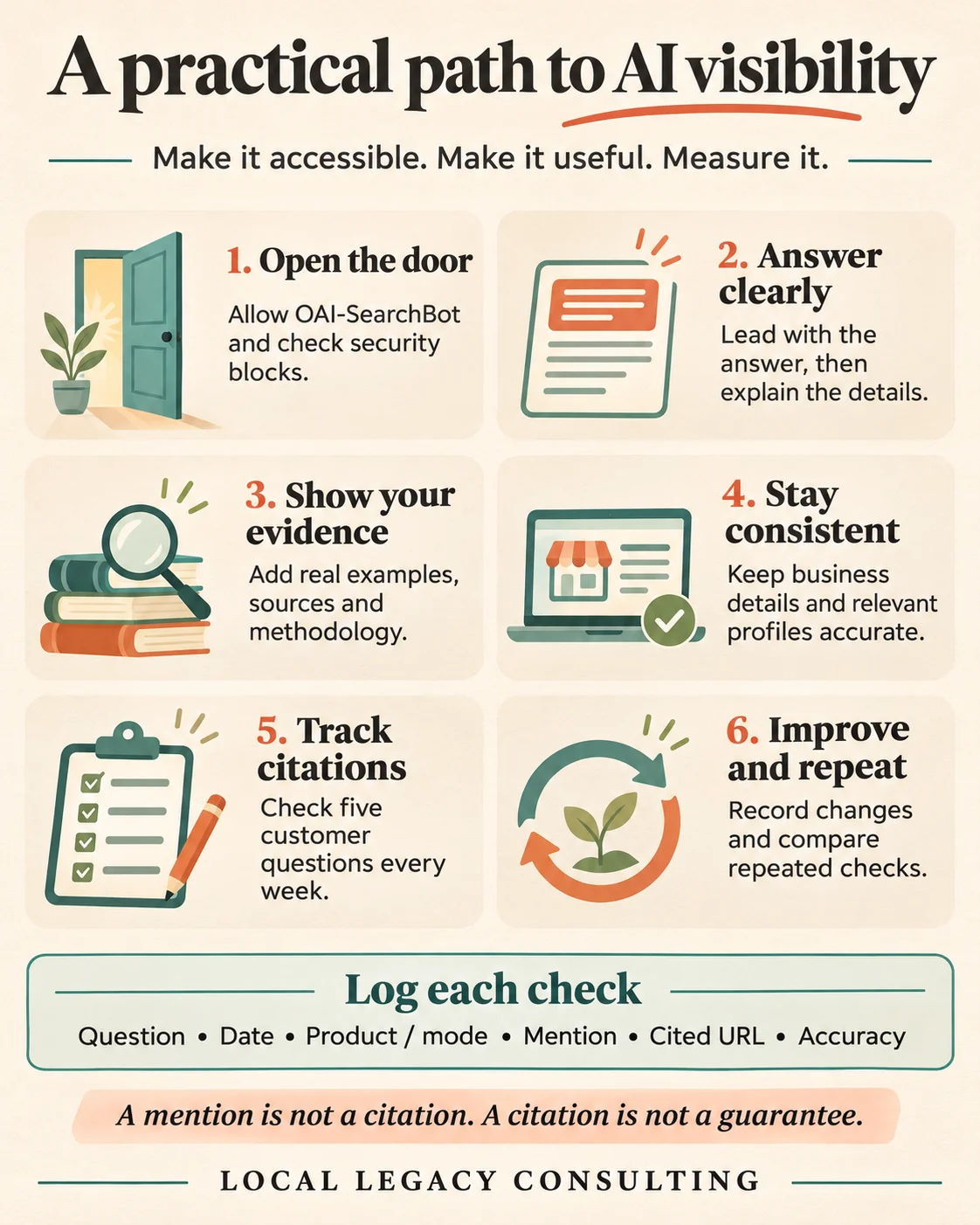
Traditional rankings cannot tell you whether ChatGPT cites your business. You need to check the answers themselves.
Start with five questions that reflect real buying decisions. For a local business, include the relevant location and service.
Run the same questions weekly in a fresh conversation with search enabled. Avoid mentioning your business in discovery questions, because that can steer the response.
Record:
| Field | What to capture |
|---|---|
| Question | The exact prompt |
| Context | Date, product, mode, and relevant location |
| Mention | Whether your business appears |
| Citation | Whether your website is linked |
| Source | The exact page cited |
| Accuracy | Whether the description is correct |
| Outcome | Any identifiable visits or inquiries |
Save the response or a screenshot so you can review the evidence later.
If you also track Perplexity or Gemini, keep the results separate. Each product is a different observation.
These checks are samples, not a complete measure of AI visibility. Answers can vary between runs. Repeated observations are more useful than celebrating one appearance or reacting to one absence.
8. Improve one thing and watch what changes
Once you have a baseline, choose a useful improvement:
- Clarify an answer that is buried.
- Add a documented example.
- Correct outdated service information.
- Explain the methodology behind a claim.
- Improve links to a relevant page.
- Fix a crawler access problem.
Record what changed and when, then continue checking the same questions.
A before-and-after improvement is a useful signal, but it does not prove causation. Search systems, competing pages, and generated answers can change during the same period.
Pair citation tracking with business results. Qualified inquiries matter more than appearances in questions your customers would never ask.
Where should you start?
Choose one important service page and five customer questions.
Check that the page is accessible. Make its answer clear. Add evidence that helps someone make a decision. Establish a weekly citation baseline, then improve the page based on what you learn.
That gives GEO a practical role in your marketing: helping your business become easier to discover, understand, and evaluate.
If you need help identifying the most useful next step, talk with Local Legacy about your website and visibility.