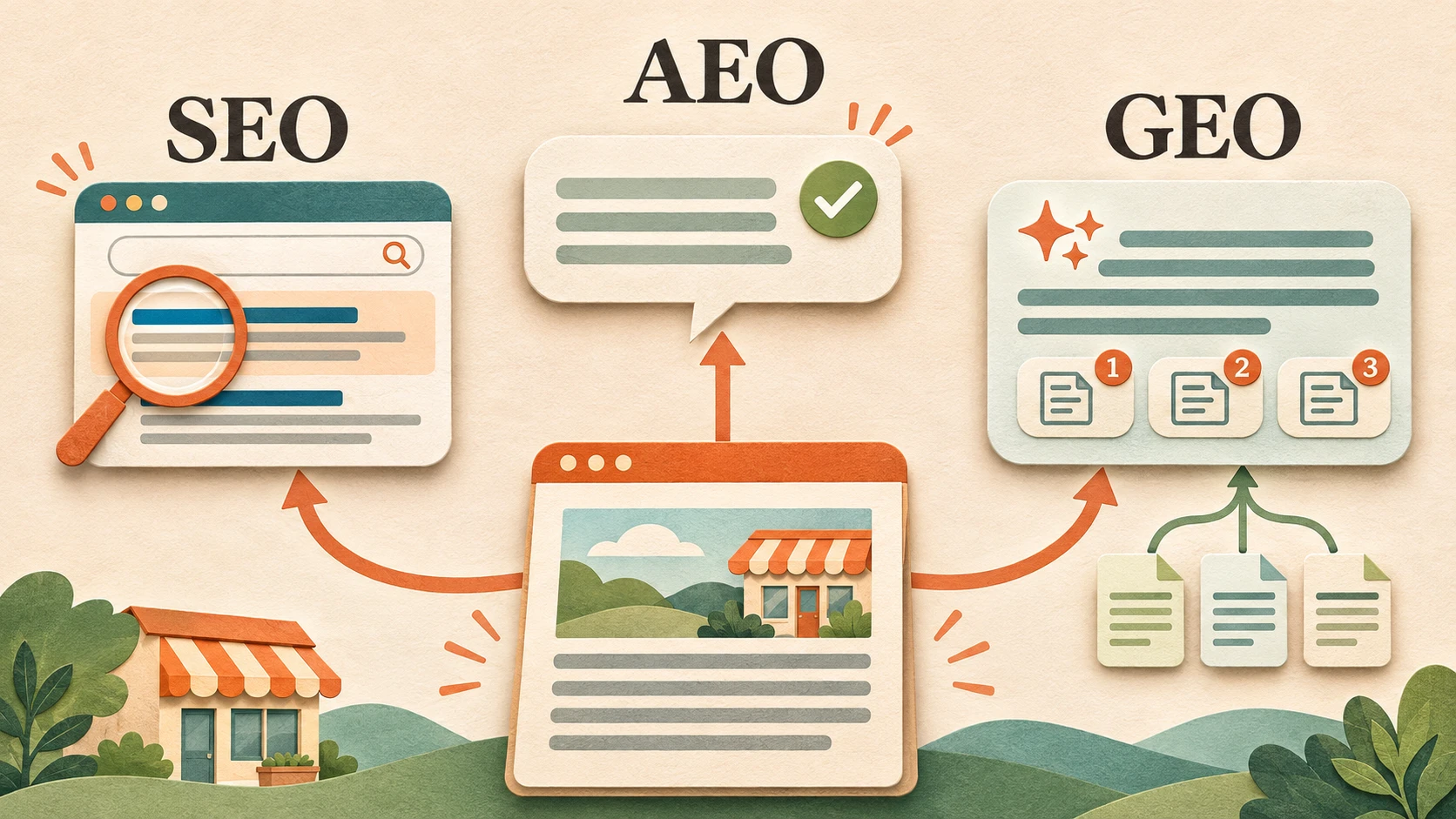
SEO helps people discover your website through search. AEO focuses on making your information useful as a direct answer. GEO focuses on how your business and content appear in responses generated by AI.
For a business owner, these are three related visibility goals. You usually do not need three separate content strategies. You need useful, credible information—and a way to measure where it appears.
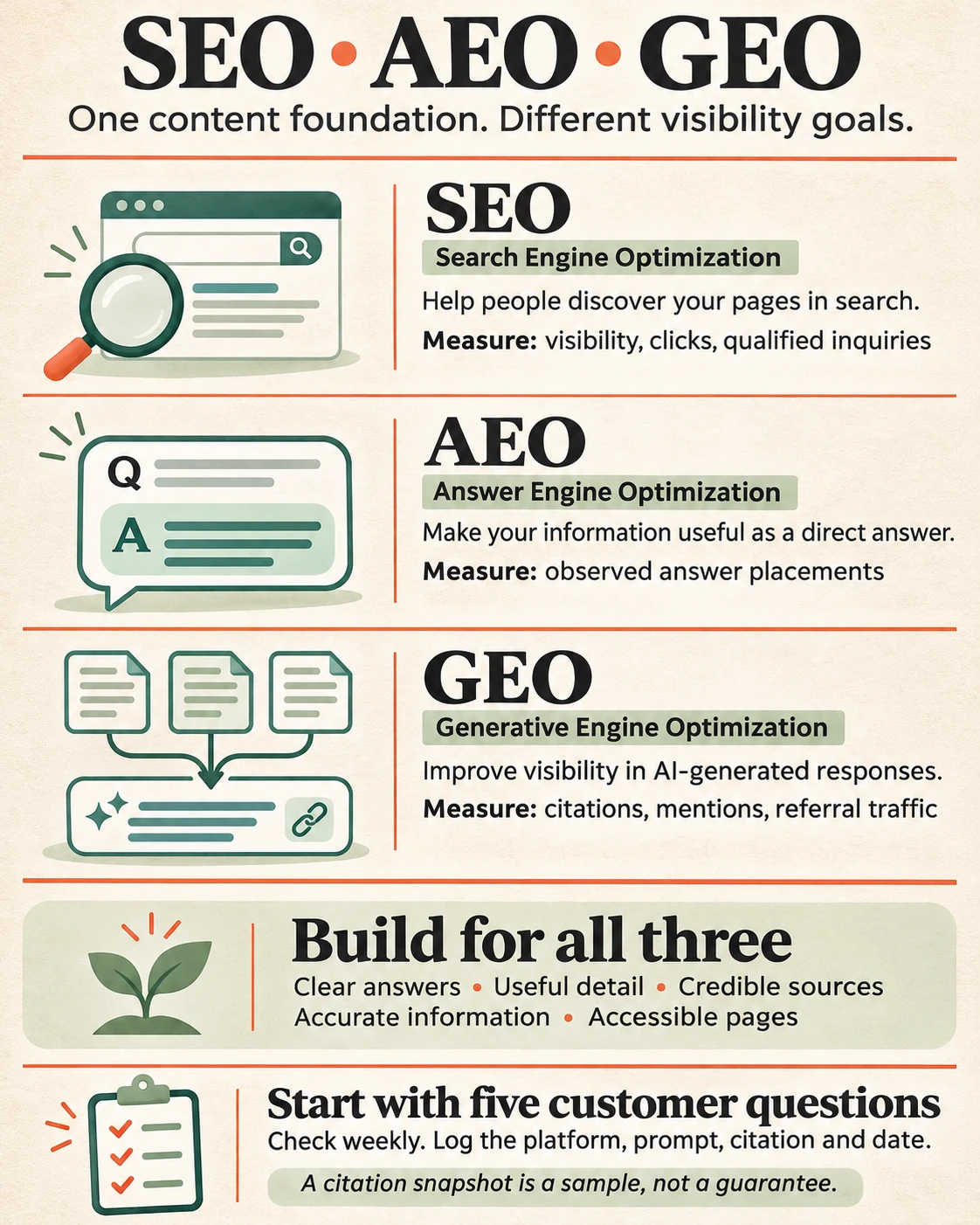
| Approach | Stands for | Main focus | What to track |
|---|---|---|---|
| SEO | Search Engine Optimization | Helping relevant pages appear in search results | Search visibility, clicks, qualified inquiries |
| AEO | Answer Engine Optimization | Making information suitable for direct answers | Featured snippets and other clearly defined answer placements |
| GEO | Generative Engine Optimization | Improving visibility in AI-generated responses | Linked citations, brand mentions, accuracy, referral traffic |
AEO and GEO are industry terms with overlapping definitions. They are not standardized labels for separate algorithms. An AI-generated answer can fall under both.
What is SEO?
Search engine optimization helps search engines discover and understand your pages so they can show them for relevant searches.
For a local business, that could mean appearing when someone searches for a service, compares providers, or investigates a problem before contacting anyone.
A useful SEO foundation includes clear service descriptions, accurate business information, accessible pages, descriptive titles, and internal links that help visitors find related information.
The business goal goes beyond rankings. A page that attracts visitors who never need your services may be less useful than one that brings a smaller number of well-matched inquiries.
Our guide to measuring local SEO results explains how to connect search visibility with actions that matter to the business.
What is AEO?
Answer engine optimization focuses on making your content suitable for answering a specific question.
Consider a customer asking:
What should I include when requesting a contractor estimate?
A useful page would answer that question directly, then explain the details. The opening might identify the project location, scope, photographs, timing, and relevant access requirements.
That structure helps the reader immediately. It also gives search systems a clear passage to evaluate for an answer placement.
However, formatting does not guarantee selection. Google determines which pages appear as featured snippets; you cannot mark a page as the chosen answer. Its guidance also does not prescribe one universal minimum answer length. Google’s featured snippet documentation
Think of AEO as improving the usefulness and clarity of your answers—not writing every page to an arbitrary word count.
What is GEO?
Generative engine optimization focuses on visibility within AI-generated responses.
When someone asks an AI search tool to explain a topic or compare options, the response may draw on several sources. Your website could appear as a linked citation, your business could receive a mention, or neither might appear.
The academic research that introduced GEO studied ways to improve source visibility in generated answers. Its findings varied across domains, which is a reason to test changes rather than assume one tactic works everywhere. GEO research paper
For a business, the practical question is:
Does our information appear in relevant AI answers, and is it represented accurately?
A linked citation and an unlinked brand mention should be recorded separately. Neither, by itself, proves that someone visited your website or became a customer.
Do AEO and GEO need different content?
Sometimes they create competing editorial priorities.
A short answer may explain a simple point well but omit the qualifications needed for a more complex question. A detailed article may contain excellent information while making the basic answer difficult to find.
That does not establish a universal rule that AEO rewards brevity while GEO rewards length. It also does not prove that gaining a featured snippet causes a page to lose AI visibility.
A practical structure accommodates both needs:
- Answer the question near the beginning. Give readers enough information to understand the main point.
- Explain the conditions. Show when the answer changes and which assumptions matter.
- Support the explanation. Include relevant examples, credible references, or original evidence.
- Make comparisons easy. Use a table when readers need to compare meaningful differences.
- Offer a useful next step. Link to a related guide, service, checklist, or contact route.
For example, an article about website costs could begin with a concise explanation of the main cost drivers, then discuss scope, ownership, ongoing expenses, and what a quote includes.
The goal is a complete answer that is easy to navigate. Adding length without useful information does not improve it.
Strong SEO still supports AI visibility
Google explicitly says its existing SEO practices remain relevant to AI Overviews and AI Mode. It does not require special AI markup or a separate optimization process for those features. Eligibility also does not guarantee inclusion. Google’s guidance on AI features
That makes the familiar work worthwhile: maintain accurate information, answer real customer questions, make important pages accessible, and connect related content.
Our local SEO plan for Southwest Florida service businesses provides a starting point for that foundation.
You can build on it with AI visibility measurement rather than replacing it with an entirely separate publishing program.
Measure AI citations directly
Traditional rankings cannot tell you whether a particular AI response cites your website.
The useful next step is to observe the answers themselves. A beginner can start with five questions that customers ask when they are seriously considering a service.
For a website business, those might include:
- What should a service-business website include?
- How should I compare website design quotes?
- Should I refresh my existing website or rebuild it?
- What information should I prepare before hiring a designer?
- What ongoing website costs should I budget for?
Choose questions that fit your actual customers. Avoid putting your business name into every prompt; that would measure a different situation from discovery by someone who does not already know you.
Run the same questions in ChatGPT, Perplexity, and Gemini, using a web-enabled mode where available. Record the product and mode used. Keep Gemini app observations separate from Google Search AI Overviews.
Use a simple log:
| Record | Why it matters |
|---|---|
| Date and exact prompt | Makes the check repeatable |
| Product, model or mode, and relevant location settings | Identifies what was actually tested |
| Whether web search occurred | Separates different answer conditions |
| Citation to your website and exact URL | Shows visible source attribution |
| Brand mention without a citation | Captures a different visibility outcome |
| Other sources cited | Shows which information appeared instead |
| Accuracy and saved answer | Preserves evidence for review |
Start weekly. Daily snapshots may help during an active experiment, but more observations are only useful if you can review them consistently.
These checks are samples. They do not reveal every answer users receive or prove whether uncited content influenced a response. An absence means “not observed in this check,” not “never used.”
Turn the baseline into useful experiments
Suppose your website receives linked citations in three of fifteen checks. Your observed citation rate for that sample is 20%.
That is a starting point, not your share of the entire AI search market. Keep results separated by platform as well, so a change in one does not hide a decline in another.
Next, choose a focused improvement:
- Add a direct answer to a page that buries its explanation.
- Explain how an original calculation or comparison was produced.
- Replace unsupported claims with evidence.
- Add a comparison table that helps readers make a decision.
- Clarify service boundaries or outdated information.
Record what changed, repeat the checks, and look for patterns over time. Where practical, compare with similar pages that were not changed.
Call this a monitored experiment rather than a controlled A/B test. Changing one page and seeing more citations later does not establish causation. Retrieval changes, model updates, competing content, and response variation can also affect the result.
Continue tracking qualified inquiries and identifiable referral traffic. Visibility is useful evidence, but it is not the final business outcome.
Where should a business start?
Choose five important customer questions. Review the pages that should answer them. Establish a search baseline and a separate AI citation baseline, then improve the weakest page.
You do not need a new article for every acronym. One well-maintained resource can help a customer find your business, understand the answer, and evaluate the next step.
If you need help deciding which pages deserve attention first, talk with Local Legacy about your website and local visibility.