
A landing page FAQ should help someone make a decision. When it introduces unnecessary concerns, repeats vague promises, or hides information that belongs in the main copy, it can make that decision harder.
The problem is not the question-and-answer format itself. It is treating an FAQ as a required section instead of asking whether it helps the person reading the page.
For a business paying to send visitors to a specific offer, that distinction matters.
How an FAQ becomes a list of reasons to hesitate
Imagine someone clicks an ad for a website redesign.
The page explains the service, shows relevant work, and offers a consultation. The visitor is interested. Then they reach a long FAQ:
- What if I don’t like the design?
- Why does a website cost so much?
- What happens if the project takes longer than expected?
- What if my website doesn’t bring in customers?
- Are there additional charges?
Those can be legitimate questions. But placing them together without specific, useful answers can turn the bottom of the page into a concentrated list of risks.
Consider this answer:
What if I don’t like the design?
We work closely with every client to ensure complete satisfaction.
It sounds reassuring, but it explains very little. What does collaboration involve? When does the client review the direction? What can they change?
The visitor now has a concern and no clear explanation of how the business handles it.
A stronger answer describes the actual process. For example, a business whose service genuinely works this way might write:
You review the proposed visual direction before we build the remaining pages. Your proposal explains the included revision rounds and how additional changes are handled.
That gives someone information they can evaluate. The wording must reflect the real service, not a process invented for the page.
Important answers belong where the decision happens
If nearly everyone needs an answer before contacting you, that information probably deserves a place in the main page.
A question about what is included belongs beside the offer. A question about timing belongs in the process section. A question about what happens after submitting a form belongs beside the form.
| Customer question | A useful place to answer it |
|---|---|
| What am I getting? | Scope or deliverables section |
| Is this suitable for my business? | Audience and service-fit section |
| How does the project work? | Process section |
| What does the price cover? | Pricing or estimate explanation |
| What happens after I inquire? | Beside the call to action |
| What ongoing costs apply? | Near pricing and ownership details |
This lets readers understand the offer as they move through the page.
Nielsen Norman Group’s FAQ guidance similarly cautions against using FAQs as a lasting workaround for problems with the interface or information architecture. Guidelines for Usable FAQs.
Before adding another question, ask: Why didn’t the page already make this clear?
A paid landing page needs a clear purpose
A landing page is simply a page someone arrives on. It can receive traffic from ads, organic search, email, or other sources.
A dedicated paid campaign page usually has a narrower job: connect a specific promise to a relevant offer and a clear next step.
If an ad promotes a website refresh for local service businesses, the destination should help that audience understand the refresh. It should explain who it suits, what it includes, and how to begin.
Google’s advertising guidance emphasizes that landing pages should match the expectations created by the ad and provide useful, relevant information. Google Ads landing-page guidance.
That does not mean every paid landing page must be short, or that it cannot support SEO. A complex service may need substantial explanation.
It means each section should earn its place by helping the visitor evaluate the advertised offer.
A broad FAQ added to capture unrelated search questions can weaken that focus.
“Good for AEO” is not enough reason to add an FAQ
Question-and-answer content can be useful when it addresses a real information need. But an FAQ section is not an automatic advantage for answer engine optimization or generative engine optimization.
Clear answers can appear in service descriptions, comparison tables, guides, and ordinary paragraphs. They do not need to sit inside an accordion labeled “Frequently Asked Questions.”
Google states that its AI search features require no special optimization or special schema beyond the relevant search fundamentals. That guidance concerns Google’s systems; it is not a universal explanation of how every AI assistant selects sources. Google’s AI search guidance.
The practical question is whether the content deserves to be there.
If a topic needs a detailed explanation, a supporting article may serve it better. Your landing page can provide the essential answer and link to more detail where that helps the reader.
Our guide to SEO, AEO, and GEO explains how these goals overlap. None requires turning every sales page into an encyclopedia.
When an FAQ can help
A focused FAQ can still be useful.
It may answer a genuine question that matters to some visitors but would interrupt the main explanation for everyone else.
Examples might include:
- Can you work with our existing platform?
- Can we keep our current domain?
- Do you serve businesses outside your local area?
- What should we prepare before the first meeting?
Whether these belong in an FAQ depends on the offer and audience. If keeping an existing domain is central to the service, explain it earlier.
Use questions from actual inquiries, sales conversations, and support requests. Avoid filling space with questions written solely to let the business praise itself.
“Why are we the best choice?” is a promotional heading disguised as a customer question.
A useful FAQ answer should leave the reader with a clearer understanding of the service, its limits, or the next step.
Do not improve conversion by hiding important information
There is a crucial difference between removing unnecessary repetition and withholding something a customer needs to know.
Costs, commitments, exclusions, cancellation conditions, and meaningful service limitations should remain clear and accessible.
If an honest explanation causes someone to decide the offer is unsuitable, that can be a good outcome. More form submissions are not automatically better if they lead to disappointed customers or unsuitable inquiries.
The goal is a confident, informed decision.
A shorter page that creates misunderstandings has not solved the problem.
Audit the questions before deleting the section
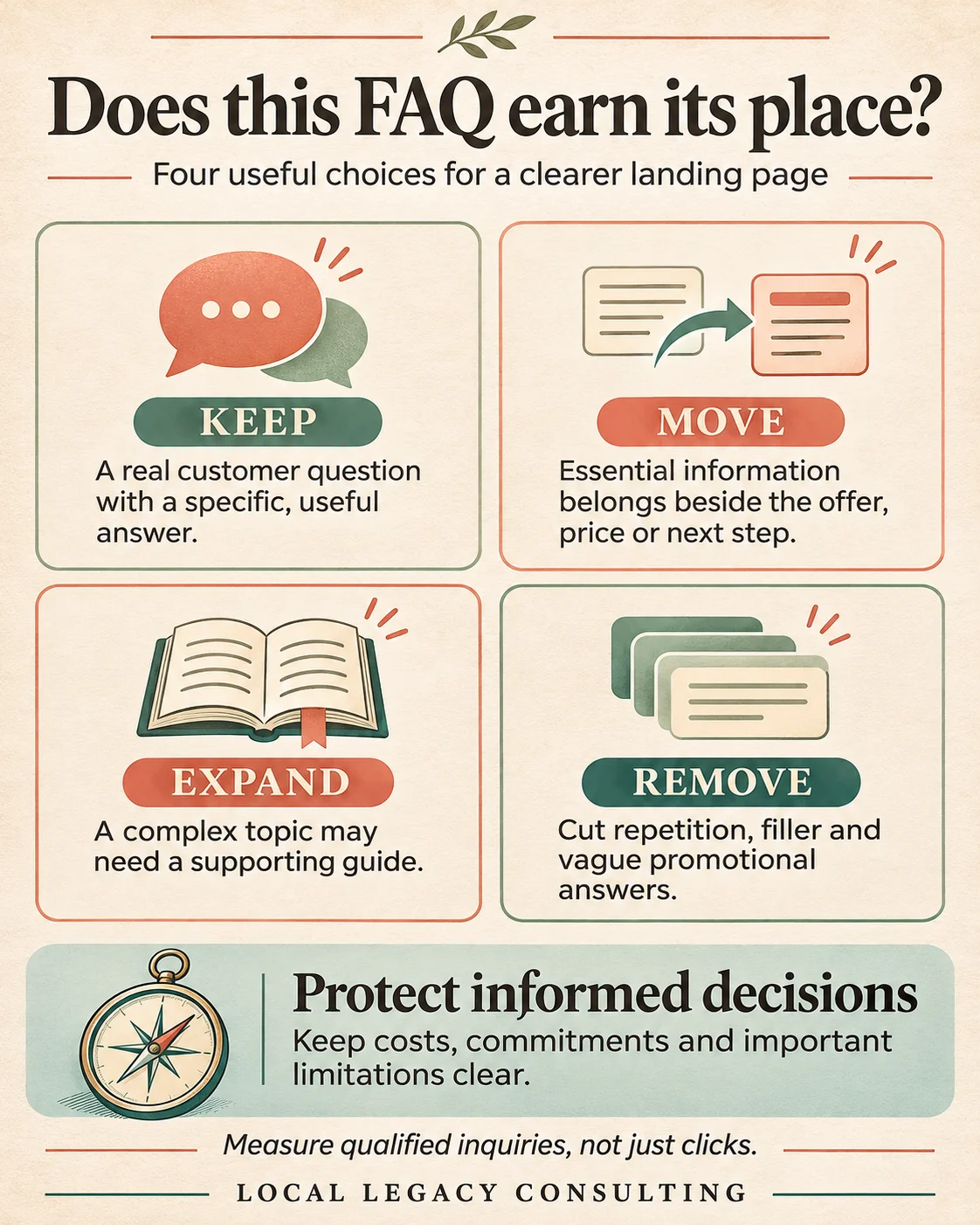
Review each FAQ using four questions:
- Do customers actually ask this? Look for evidence in conversations and inquiries.
- Does the answer help them decide? Replace vague reassurance with specific information.
- Is this the right location? Move essential information beside the relevant offer, price, or action.
- Does it need more space? Use a supporting resource when the explanation goes beyond the page’s purpose.
Then choose whether to keep, move, expand, or remove it.
Removing an FAQ section may be appropriate. So may keeping a small, useful one. The decision should follow the content and audience rather than a template.
Test the result with meaningful measures
There is no reliable basis for assuming that FAQs generally decrease conversions across all landing pages.
The effect depends on the questions, answers, offer, visitor intent, and placement.
If your traffic supports an experiment, compare your current page with a version that moves essential answers into the main copy and removes redundant questions. Keep the offer and traffic allocation comparable, and define success before reviewing results.
Measure more than button clicks:
- Completed inquiries.
- Qualified inquiries.
- Booked appointments or sales.
- Repeated questions during follow-up.
- Cancellations or misunderstandings.
FAQ opens and scroll depth can help explain behavior, but they do not prove that the section helps or hurts conversion. People who open an FAQ may already have more uncertainty than those who do not.
For a lower-traffic business, customer interviews and observed usability sessions can reveal confusing language before a conversion test has enough data to support a conclusion.
Make the offer clearer before making the FAQ longer
An FAQ should support a page that already explains its offer well.
If visitors reach the bottom still unsure what they receive, who the service suits, or what happens next, revisit the main explanation.
Answer essential questions where they arise. Support claims with evidence. Keep useful details easy to find. Give visitors a clear next step.
Then keep the FAQ only where it contributes something valuable.
If your landing page needs a clearer offer and a more useful path to inquiry, talk with Local Legacy about your website.