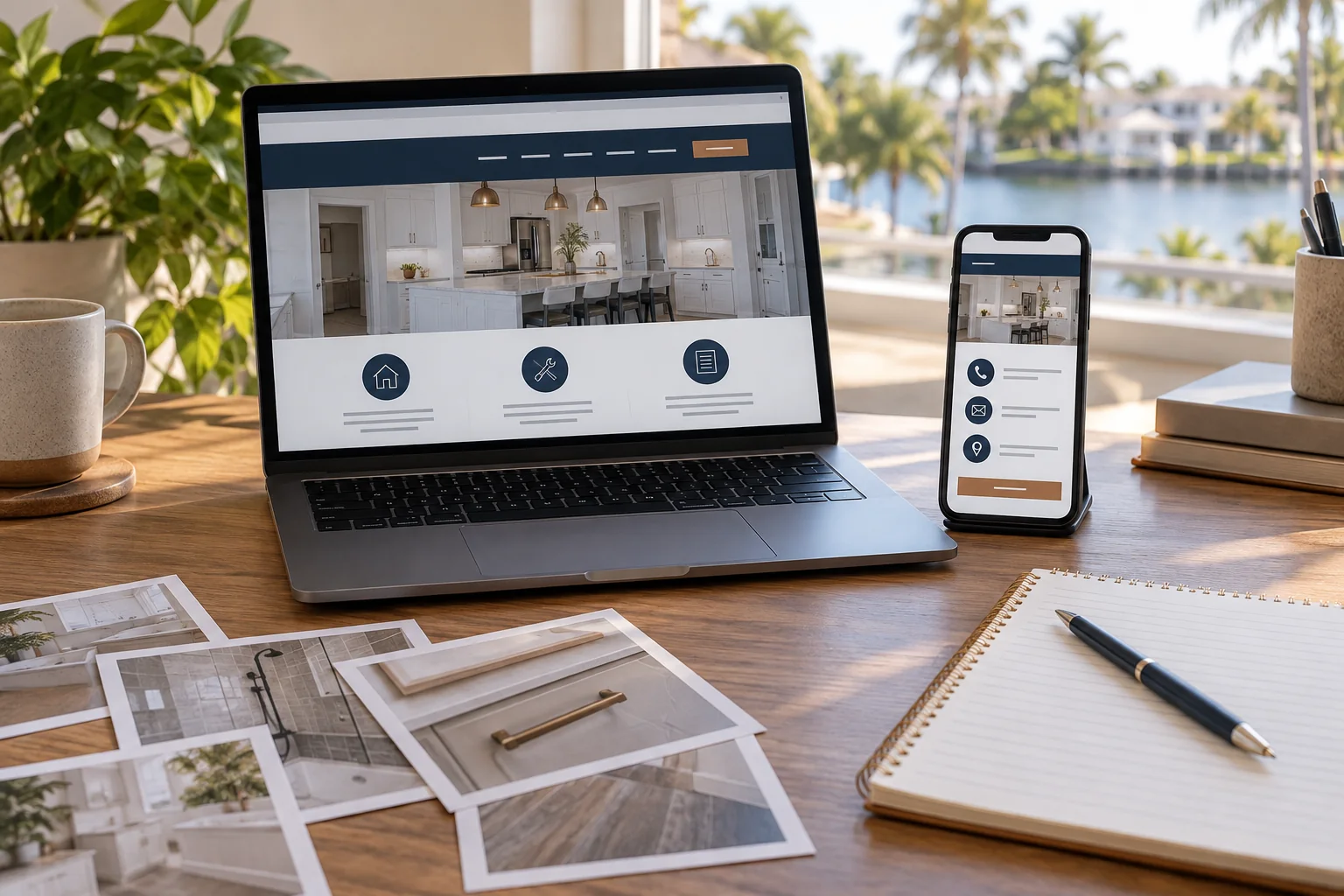
A useful service-business website must explain the work, establish whether the customer is a fit, show credible proof, and make the next step easy. Start with those four jobs before deciding how many pages to buy. A contractor, a professional practice, and a wellness business may share that framework while needing different content and contact processes.
For a Port Charlotte owner, local relevance comes from accurate service coverage, real work, and useful operating information. Repeating the city name across a template does little to answer a customer's actual questions. Use the checklist below to prepare a brief for your designer; a downloadable one-page checklist is included at the end.
Begin with the customer action
Choose the main action the website should help a suitable visitor take. A contractor might need an estimate request with the job type and location. A consultant may need an initial conversation. A wellness business might need an appointment request through its approved booking process.
Write down what happens after that action. Who receives it? What can the visitor expect? What information does the team need to respond? That defines the content and form more reliably than choosing a contact-page template first.
Local Legacy begins by learning how the business works, who it needs to reach, and what visitors should be able to do. We handle structure, design, build, mobile layout, basic SEO setup, and launch. We also help turn the owner's knowledge into clear copy. You confirm the service facts, photos, access, and requirements only your business can supply.
Give each important service enough explanation
A service page should answer: what work do you accept, who is it for, what is included, what falls outside it, and how does someone start? Add real examples or preparation advice where they help someone decide.
Use distinct pages when the customer questions or inquiry process differ. Keep closely related services together when separating them would produce several thin pages. A small business can launch with a concise site if the important decisions are still answered.
Our Florida Engineering case study shows the larger version of this problem: more than 50 service pages were missing when we took over, and the customer journey needed a clearer route to the right service and a quote. That is a reason to expand content based on the offering, not a reason for every local business to build dozens of pages.
Explain where and how customers can work with you
Distinguish visiting your premises, traveling to the customer, and delivering a service remotely. State your actual coverage and any service-specific limits before asking someone to fill out a long form.
For example, a Port Charlotte operator might also accept work in Punta Gorda or selected jobs in North Fort Myers. Publish that only if it reflects the business's real policy. If coverage depends on project size or service type, say that and ask for the location during the inquiry.
Include an address and arrival information when customers genuinely visit. For a business that travels to customers, describe the service area without implying staffed offices in other cities. Google's business representation guidance calls for accurate address or service-area information in a Business Profile. Keep that information consistent with how your website describes the operation.
Match proof to the decision a customer is making
| Business type | Useful proof | Information to prepare |
|---|---|---|
| Contractor or home-service company | Approved project photos and relevant credentials | Actual scope, work performed, permitted location detail, permission to show the project |
| Professional-service business | Clear team roles, service explanations, and suitable project examples | Who handles the work, qualifications that can be verified, confidentiality limits |
| Wellness or appointment business | Accurate service descriptions, team information, and genuine premises photos | Booking requirements, approved practitioner details, what a visitor should expect |
| Local operator with several services | Examples grouped by service | Which evidence supports which offer, and whom the customer should contact |
Our Port Charlotte work includes Florida Engineering, LED Grow Lights Depot, Empower Packs, and Viva Beauty & Wellness. Their needs differ. Use relevant work to explain your business rather than borrowing another industry's proof format simply because it looks attractive.
Give galleries useful captions. A photo should identify the work shown and your role when those facts can be shared. Use authentic reviews with their meaning intact and identify the source where appropriate. Stock or generated images may illustrate an idea, but they should not be presented as completed customer work.
Make calls and forms work on a phone
Use readable service content, a usable menu, a working phone link, and clearly labeled form fields. Start with the information your team needs for the next step. A project type, town or ZIP code, short description, and preferred contact method may be more useful than an elaborate questionnaire.
W3C's forms tutorial recommends clear labels and feedback and asking only for information required by the process. Test both a successful submission and a missing-field error. A visitor should know whether the request arrived and what happens next.
A contractor may benefit from optional project photos and timing questions; our quote-request guide covers that deeper workflow. A professional practice may need a separate route for existing customers. Keep sensitive case or health details out of a general contact form and use the business's approved intake process when required.
Prepare a simple operating-status notice
For a Port Charlotte business, plan how you will communicate a hurricane-related closure or another interruption before you need the notice. This is a content responsibility: decide who can update hours, appointment availability, service coverage, and the preferred contact method.
A useful notice contains a visible update date, the affected services, what existing customers should do, and the next expected update. Use it for verified business information. Do not let an old “temporarily closed” banner remain after normal operations resume, or promise emergency availability the team cannot provide.
Store a short approved notice template with the owner's website handoff. Test that the person responsible can update it from the device they will actually use. Keep website hours and other customer-facing channels aligned when the business changes them.
Include search foundations and an owner handoff
Ask the proposal to include descriptive page titles, clear headings, relevant internal links, an indexable public site, and a sitemap. Business information and any structured data should describe the real operation. These are foundations for a useful website; they do not guarantee a search position.
For handoff, name the people responsible for the domain, hosting, content updates, inquiries, and renewals. Confirm what you can edit, where access is held, and what happens when you change providers. Our hiring guide supplies questions to put to a designer, and our cost guide explains the pricing choices.
Do I need a separate page for every nearby city?
No. Begin with an accurate coverage explanation. Add a location page only when it can provide distinct, useful information about actual operations. Copying the same service description with different city names does not help a customer choose.
Do I need professional photography before we start?
You need truthful, usable imagery with permission. Share what you already have so the scope can identify any gaps. Do not delay the business and page-planning conversation while trying to produce every final asset.
What belongs in the first launch?
Accurate services, appropriate proof, clear coverage, and a tested contact route come first. Additional articles or a larger gallery can follow if the initial site still lets a customer make an informed decision.
Download your website planning checklist
Download the Port Charlotte website planning checklist (PDF). Use it to gather the facts, mark gaps, and name the person responsible for the next decision. It is a one-page owner brief you can print and bring to a project conversation.
Plan your Port Charlotte business website. Share the completed brief and your current site. Our Port Charlotte services and website-design process explain how we turn that information into a scoped project.