
A small business brand strategy becomes useful when it helps people make ordinary decisions: which logo file belongs on a light background, how to describe the main service, what proof supports a claim, and whether a proposal should sound like the website that earned the inquiry.
This guide turns that strategy into a repeatable brand consistency checklist for your website, Google Business Profile, social channels, email, sales materials, signs, vehicles, and customer follow-up. It is designed for an owner-led team that needs clarity—not a hundred-page brand manual.
Brand consistency is not sameness
Consistency means the business is recognizable and accurate as a customer moves from one touchpoint to another. It does not mean pasting the same layout onto a truck, an Instagram post, a proposal, and a mobile website.
Some elements should stay stable:
- the business name and essential contact information;
- the core customer, problem, promise, and services;
- the standards behind claims, proof, and testimonials;
- a controlled logo family, color palette, type system, and image direction; and
- the tone customers should hear, even when the format changes.
Other elements should adapt. A storefront sign needs immediate recognition. A service page needs detail. A social post may be conversational. A proposal needs precise scope. The strategy is consistent when those pieces feel related and do not contradict one another.
That distinction keeps a small business from treating every variation as a mistake—or every random design choice as creative freedom.
Build a one-page brand source of truth
Before auditing channels, write down the decisions those channels are supposed to follow. Keep the first version short enough that a new employee, freelancer, printer, or marketing partner can use it in one sitting.
Position
Complete these sentences in plain language:
- We help: the specific people or businesses you serve best.
- With: the problem, job, or result they are trying to handle.
- By: the services or products you actually provide.
- Unlike a poor-fit alternative: the meaningful difference in your process, specialty, ownership, service model, or point of view.
Avoid empty superlatives such as “best,” “premier,” or “world-class” unless you can define and substantiate them. A useful position helps a customer understand fit; it does not simply praise the company.
Message hierarchy
Document:
- one short description of the business;
- one fuller paragraph for profiles and proposals;
- the primary services and the exact names used for them;
- the most important customer questions;
- approved proof, credentials, and limitations; and
- one primary next step, such as call, book, request an estimate, visit, or buy.
This is the verbal core of your small business brand strategy. If the homepage promises one thing while the proposal leads with something else, visual polish will not repair the confusion.
Voice
Choose three useful voice traits and define what each one changes. “Friendly” is vague. “Neighborly: use direct, respectful language and explain unfamiliar terms” gives a writer something to follow.
Add a short “do / avoid” list. Include preferred service names, capitalization, point of view, common words, and phrases the business does not use. Save approved examples of a headline, social caption, estimate email, and customer response.
Visual identity
Your minimum brand identity for small business use should include:
- primary, horizontal, stacked, one-color, and small-size logo options when needed;
- original vector files plus web-ready exports;
- exact color values for screen and print;
- headline and body typefaces with practical substitutes;
- rules for spacing, backgrounds, cropping, icons, and photography; and
- a few finished examples across the channels your business uses most.
The U.S. Patent and Trademark Office explains that a word, phrase, symbol, design, or combination can function as a trademark by identifying the source of goods or services. Registration and usage questions are legal matters, so use the USPTO trademark basics as a starting point and seek qualified legal advice when protection or clearance matters.
Inventory the customer journey before fixing designs
Do not begin with the asset that annoys you most. Begin with the path a real customer is likely to take.
| Journey stage | Common touchpoints | What must match | Useful owner |
|---|---|---|---|
| Discover | Google result, Business Profile, social profile, sign, vehicle | Name, category, service, location or service area | Owner or local visibility lead |
| Evaluate | Website, reviews, project examples, social posts, brochure | Promise, proof, tone, visual identity | Marketing or sales lead |
| Decide | Service page, estimate, proposal, booking page, sales call | Scope, price path, next step, expectations | Sales or operations lead |
| Experience | Confirmation, invoice, onboarding, uniform, packaging | Instructions, voice, contact details, delivery standard | Operations lead |
| Return or refer | Follow-up email, review request, reminder, referral card | Name, gratitude, next action, privacy-safe request | Customer-service lead |
Collect one current example from every important row. Use the materials customers actually receive—not only the polished master files. A saved template may be correct while the version attached to yesterday's email is not.
Run the audit in the right order
The fastest brand audits fix risk and confusion before decoration.
1. Correct inaccurate identity information
Check the business name, website, phone, email, hours, address or service area, primary category, social handles, and offer details. Highlight contradictions and retired information first.
For Google Business Profile, the business name should reflect the real-world name used consistently on the storefront, website, stationery, and other branding. Google also requires accurate address or service-area information. Review the current Business Profile representation guidelines before changing names or locations; do not add keywords to the profile name simply to chase visibility.
2. Align the promise and offer
Compare the first screen of the website, profile descriptions, pinned social content, current ads, proposal opening, and the words staff use on the phone.
Ask:
- Do they describe the same primary customer?
- Are the service names consistent?
- Is the business promising something operations can deliver?
- Does each channel send the customer to a logical next step?
- Are seasonal or discontinued offers still visible?
This step often reveals a strategy problem disguised as a copy problem.
3. Verify claims, reviews, and proof
Create an approved proof library. Record the source, permission, date, applicable service, and any limitations for each testimonial, credential, project image, statistic, award, or outcome claim.
The Federal Trade Commission says endorsements must be truthful and not misleading, and material connections that could affect how people evaluate an endorsement should be disclosed. Its current consumer reviews and testimonials guidance is a better standard than copying whatever competitors happen to publish.
Remove invented badges, expired credentials, anonymous quotes you cannot trace, and outcome claims the evidence does not support. Consistent repetition does not make an unsupported claim safer.
4. Standardize the visual system
For each touchpoint, check:
- correct logo version and safe spacing;
- approved colors rather than close guesses;
- readable typefaces and hierarchy;
- consistent photo treatment, illustration style, and icon family;
- intentional button, form, document, and card patterns; and
- enough flexibility for light, dark, small, horizontal, and print uses.
Do not judge a color only by whether it matches the palette. It also has to work in the assigned role.
5. Protect readability and accessibility
Brand rules should not force unreadable marketing. WCAG 2.2 requires at least 4.5:1 contrast for normal text and 3:1 for large text at Level AA, with defined exceptions. It also says color should not be the only visual way information is conveyed and generally favors real text over images of text. Use the W3C contrast guidance and use-of-color guidance when documenting digital color combinations.
Test button labels, form text, links, social graphics, email banners, and text placed over photography. A logo exception does not make low-contrast body copy part of the brand.
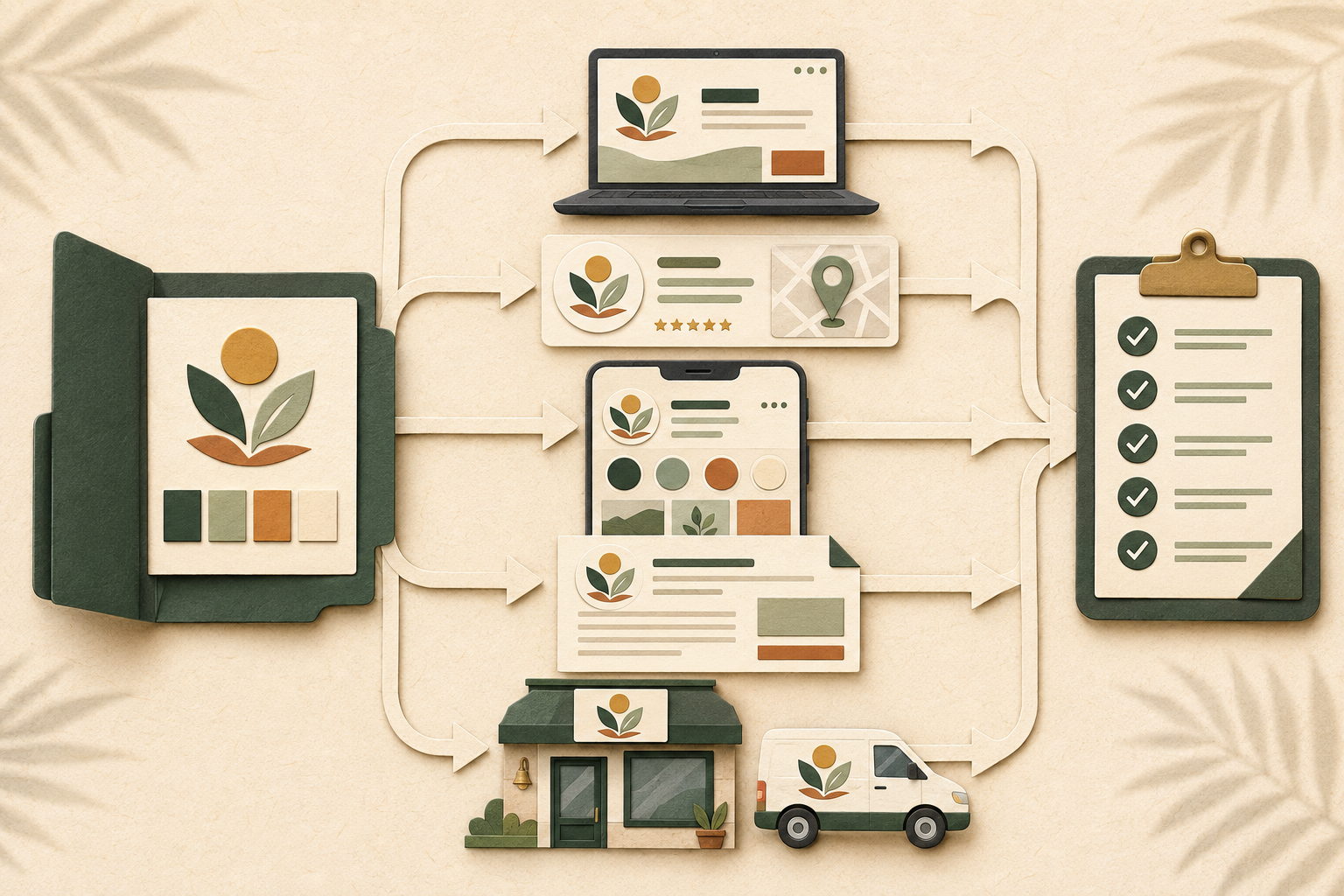
Use this channel-by-channel brand consistency checklist
Website
- The homepage states who the business serves, what it provides, and the next step.
- Service names match proposals, profiles, ads, and internal language.
- Logo, colors, typography, image style, buttons, and form patterns follow the current system.
- Team, project, review, credential, and contact information is current and permissioned.
- Mobile pages preserve the hierarchy instead of merely shrinking the desktop layout.
- Accessible text, links, forms, alternative text, focus states, and contrast survive brand styling.
If the site creates doubt even when the identity is consistent, use the website trust signals guide to inspect proof and safer customer actions. If the business needs a new web foundation, review Local Legacy's small-business website design service.
Google Business Profile and local listings
- The public business name matches real-world branding.
- Phone, website, hours, address or service area, and category are accurate.
- Profile description, services, and images reflect current operations.
- The website landing page supports the same service and local context.
- Holiday, storm, closure, and seasonal updates have a named owner.
- Old locations, duplicate profiles, tracking numbers, or inconsistent names are investigated carefully rather than edited casually.
For a Fort Myers, Cape Coral, or broader Southwest Florida service business, operational accuracy matters more than decorating the profile. Local customers should not have to reconcile different names, hours, or service boundaries before deciding whether to call.
Social profiles, email, and campaigns
- Handles, profile names, biographies, links, and profile imagery are coordinated.
- The channel's tone adapts without becoming a different personality.
- Reusable templates allow variation while preserving hierarchy and recognition.
- Every campaign has one approved offer, claim set, destination, and date range.
- Scheduled content is reviewed when hours, services, staff, weather, or availability changes.
- Paid or gifted relationships are disclosed where required.
The goal is not constant posting. Local Legacy's social presence service focuses on complete profiles, reusable direction, and content tied to a useful customer path.
Proposals, estimates, invoices, and follow-up
- Current templates use the correct business name, entity details, contact information, and logo.
- Service names and descriptions match the website.
- Scope, exclusions, timelines, ownership, and next steps are clear.
- The document is readable on a phone and printable without losing critical information.
- Email signatures and automated messages use active links and monitored inboxes.
- Old templates are archived so staff cannot accidentally reuse them.
These materials are part of the brand because they shape the experience after a customer raises a hand. A beautiful website followed by a confusing estimate is one broken journey.
Signs, vehicles, uniforms, packaging, and local events
- The mark is legible at the real viewing distance and reproduction size.
- Phone numbers, URLs, QR codes, and calls to action are tested before production.
- Vendors receive the right file type, color specification, and proofing instructions.
- Materials reflect the correct location, service area, and active offer.
- Staff can explain the business with the same short description used elsewhere.
- Event materials have a plan for storage, reuse, correction, or retirement.
Physical materials cost more to replace than a social graphic. Proof them against the source of truth, and ask someone outside the project to test the phone number, URL, and QR destination before approval.
Keep a gap register, not a vague brand score
A single score can hide whether the real problem is an incorrect phone number or a slightly wrong shade of green. Record the issue in a short working table instead.
| Field | What to record |
|---|---|
| Touchpoint | Exact page, profile, template, sign, vehicle, or document |
| Issue | The visible contradiction or missing rule |
| Type | Accuracy, message, proof, voice, visual, accessibility, or ownership |
| Risk | What could confuse a customer or block the team |
| Correct source | The approved fact, file, phrase, or standard |
| Owner | One person responsible for the correction |
| Due date | A realistic date tied to impact and production cost |
| Verified | Who checked the finished change and when |
Fix high-risk accuracy, policy, and customer-path issues first. Then address frequently seen touchpoints. Save low-impact cosmetic cleanup for last.
Review the register after a new service, location, team member, campaign, platform, vehicle, sign, acquisition, or major website change. A quarterly review is a useful operating rhythm for many small teams, but the right cadence depends on how often the business changes and publishes.
Add a Southwest Florida operating check
Local brands move between digital and physical touchpoints quickly. A customer may see a wrapped vehicle in Cape Coral, search the name later, compare the website from Fort Myers, and request an estimate after reading a Google profile or neighborhood recommendation.
Add these regional operating questions where they apply:
- Are storm closures, temporary hours, and service interruptions updated in every customer-facing system?
- Do location pages and profiles describe real operations rather than copied city names?
- Are seasonal residents and year-round customers receiving accurate availability and service information?
- Do vehicle, sign, event, and referral materials lead to a current mobile page?
- Is the same business identity used across Fort Myers, Cape Coral, and the wider Southwest Florida service area without pretending each city is a separate business?
Consistency should make local service easier to understand. It should never become a reason to manufacture locations, reviews, or claims.
Know when the checklist is not enough
A consistency audit assumes the underlying strategy and identity are still sound. It can organize scattered files, repair inaccurate touchpoints, clarify usage rules, and stop everyday drift.
A focused brand refresh may be appropriate when the position is still right but the visual system or templates cannot handle current channels. A broader rebrand may be necessary when the audience, services, name, reputation, market position, or business direction has changed.
Use the Fort Myers rebranding warning signs to make that larger decision. The useful outcome of an audit is sometimes “keep the brand and operate it better.” It should not assume a redesign is always the answer.
Frequently asked questions
What should stay consistent across a small-business brand?
Keep the business identity, customer, core promise, service names, proof standards, voice principles, logo family, colors, typography, imagery direction, and primary customer actions consistent. Adapt layout, length, and tone to the channel without changing the underlying facts.
Is brand consistency only visual?
No. Visual identity is one layer. Customers also encounter names, service descriptions, claims, prices, hours, calls to action, phone conversations, proposals, follow-up, and delivery. A consistent-looking system can still fail when those elements contradict one another.
Does a small business need brand guidelines?
It needs enough guidance to prevent repeated decisions and mistakes. Start with a one-page source of truth, a well-organized asset library, a few channel examples, and named owners. Expand the guidelines when the team, vendors, locations, or applications create recurring questions.
How often should I run a brand audit?
Review high-risk facts whenever operations change. Run a broader cross-channel check after a new service, location, campaign, platform, hire, acquisition, website launch, or major physical-production order. Many small teams also benefit from a scheduled quarterly review, but frequency should follow the rate of change.
What is the difference between a refresh and a rebrand?
A refresh improves how a sound strategy is expressed—often through refined visuals, templates, photography, or website presentation. A rebrand revisits more fundamental decisions such as audience, position, promise, name, or identity. Audit first so the scope matches the problem.
Can one brand stay consistent across several cities?
Yes. Keep the core identity and offer stable, then adapt verified service details and useful local context. Do not duplicate pages or create profiles for locations that do not exist. Each city touchpoint should clarify how the same real business serves that area.
Make the strategy easy to use
The best small business brand strategy is not the document with the most rules. It is the system that helps the next person publish the right message, use the right asset, make a truthful claim, and send the customer to the right next step.
Local Legacy Consulting helps small and local businesses turn positioning, identity, websites, profiles, and everyday materials into one practical system. Explore brand development for small businesses, see our work across Fort Myers and Cape Coral, or start a brand conversation.