Before commissioning a custom website, write down who you want to hire your business, which services you want to sell, and what a visitor should do next. Then gather the information and proof that help someone make that decision. Those answers give a designer something more useful than a list of websites you like.
A good brief does not require technical language. It needs to explain the business clearly enough that you and your designer can agree on what the site must accomplish, what is included, and how you will know it is ready.
For a Southwest Florida service company, that might be a website that helps homeowners understand a particular project, see relevant completed work, and request an assessment within the actual service area. Every major page should support that customer path.
Start with the work you want more of
“We need a modern website” describes a starting concern. It does not tell the designer which business opportunity to prioritize.
Write a more specific statement:
Illustrative brief: We want more inquiries for planned residential renovation projects within our actual service area. The website should explain our project scope, show approved examples, and help homeowners request a consultation. We also need to distinguish those projects from repair work we do not offer.
This is a fictional example, not a client result. Its value is the decision it makes: one kind of work and one useful next step lead the design.
Choose a primary objective and a few supporting tasks. If full renovation projects are your priority, they should not compete equally with every small repair service in the first screen. If repeat customers also need support, give them a clear route without letting that task dominate the sales journey.
Define the customer and service area together
Describe the person making the purchase and the information they need before contacting you. A homeowner planning a renovation has different questions from a property manager arranging recurring maintenance.
Then list the places you actually serve. A business based near Fort Myers may cover several communities, but its website should explain real coverage and relevant service limits. It does not need a near-identical page for every neighborhood.
Useful details for the brief include:
- The services you want to feature first.
- The customer situations that are a strong fit.
- Work you do not undertake.
- Actual coverage, travel limits, or appointment restrictions.
- Questions customers ask before they are comfortable getting in touch.
If you work with seasonal homeowners, identify any arrangements you really provide, such as remote project updates or coordination with a property manager. Do not include them simply because they sound locally relevant.
Plan pages around customer questions
Page count is a scope decision, but it should follow the information people need. Begin with the questions, then decide where each answer belongs.
| Customer question | Content the website needs | Likely location |
|---|---|---|
| Can you do this kind of work? | Clear service scope, suitable projects, exclusions | Service page |
| Have you handled something relevant? | Approved project photos and accurate description of your role | Work or project page |
| Do you serve my area? | Real coverage and any location-related limits | Service-area section or useful location page |
| What happens if I contact you? | Consultation, assessment, or quotation process | Service and contact pages |
| Who will I be working with? | Business identity, team information, and relevant experience | About page |
A custom website can organize these answers around your business rather than forcing every offer into the same generic layout. Custom design still needs sensible structure and clear writing. It is not a reason to add unusual navigation or animation that makes information harder to reach.
Google's SEO Starter Guide describes clear organization and useful content as parts of making a website understandable. Ask the designer to explain the proposed page structure in terms of the visitor's task.
Gather proof before the design needs it
Create a folder of material you have permission to use:
- Original project photographs, with a note explaining each project.
- Your actual contribution: design, installation, maintenance, or another specific role.
- Customer feedback approved for the intended use.
- Current business details and relevant credentials you can substantiate.
- Brand files, team photographs, and existing content worth preserving.
Separate real client work from concepts, demonstrations, and stock images. A design concept can show a style; it should not be presented as a completed customer project. Our website trust-signals guide explains how to connect claims with appropriate evidence.
You do not need every image before the first conversation. You do need to know what exists, what requires permission, and what must be created. That prevents an attractive design from reaching the content stage with no accurate material to fill it.
Decide who handles the inquiry
A working contact form is part of a business process. Write down where a request goes, who reads it, and what they need to respond.
For a consultation request, the relevant information might be the service, approximate location, a short project description, and a contact method. Ask for more only when it supports the next step. Avoid making an unfamiliar visitor complete a full project specification just to start a conversation.
Choose a response expectation the team can meet. A preferred appointment date is a request unless your booking system actually reserves that time. The button and confirmation should describe the same transaction; our call-to-action guide covers that connection.
Include any existing email, scheduling, or customer-management systems in the brief. The designer needs to know what must connect and who controls those accounts. Share access through an agreed secure process rather than pasting passwords into the project document.
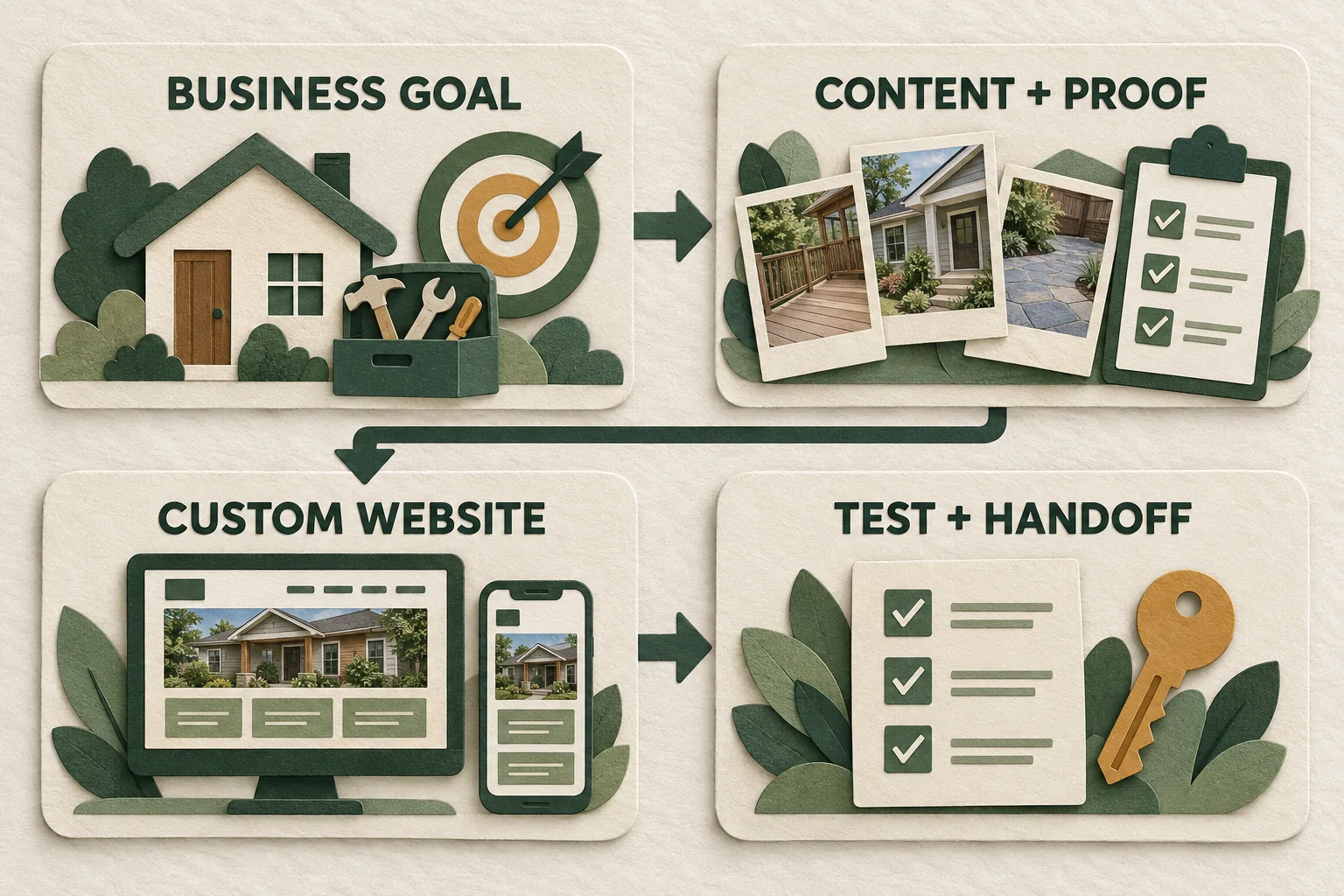
Copy this brief into your project notes
| Brief field | Your answer should cover |
|---|---|
| Primary business goal | The type of work or inquiry the website should support |
| Primary audience | Who makes the buying decision and their main concern |
| Priority services | What leads the site; what belongs in a supporting role |
| Service area | Actual locations served and any operational boundaries |
| Customer questions | What someone needs to understand before contacting you |
| Existing assets | Domain, site, useful content, photography, and brand files |
| Evidence available | Approved project details, feedback, and verifiable credentials |
| Main action | The specific request the visitor can make |
| Inquiry owner | Who receives, reviews, and responds to requests |
| Content responsibilities | Who supplies facts, writes copy, approves it, and gathers images |
| Project constraints | Budget context, real deadlines, account access, and integrations |
| Launch acceptance | The pages, functions, and checks that must be complete |
| Ongoing ownership | Who can edit content and who maintains the website |
Keep unknowns visible. “Need help choosing” is a useful answer for a platform or content responsibility that has not been settled. Pretending every decision is final makes the proposal less reliable.
Agree on what “ready to launch” means
Put acceptance criteria into the project discussion early. They can include approved content, functioning inquiry delivery, mobile layouts, usable navigation, and ownership/access handoff.
Accessibility also needs an owner and a review process. W3C's planning guidance treats it as work to integrate through a project, not something to assume from appearance alone. Ask how forms, navigation, text, and images will be evaluated for the audience using them.
For an existing website, identify useful pages and content before agreeing to replace them. A new design can preserve valuable material, but that work must be in the scope. Our website-cost guide can help you compare proposals and ongoing responsibilities once the brief is clear.
Questions before commissioning a custom site
Do I need to choose the platform first?
You need to describe the requirements first. The platform discussion can then account for editing, integrations, portability, care, and budget. Use our website-platform questions to assess the proposed choice.
Do I have to write all the content myself?
That depends on the agreed scope. The business must supply accurate facts and approve the finished message. Copywriting, editing, and photography responsibilities should be explicit in the proposal.
Will a custom website automatically bring more customers?
No. A clear website can support discovery and inquiry, but traffic, demand, proof, follow-up, and service fit also matter. Define the desired inquiry and measure whether the site helps suitable prospects reach that step.
Bring the business brief; we can help shape the website
Local Legacy Consulting's custom website-design service connects planning, content, design, and the customer journey. Explore our work, then bring your current website, priority services, and the answers you already have.
Discuss a custom website for your business. We can help turn the brief into a practical scope for a site built around the work you want to win.