Have you noticed lower website traffic, fewer useful inquiries, or more people asking whether you still offer a service? An older website may be part of the problem. When its message, appearance, and customer experience no longer match the business, it can make good work harder to recognize and a capable company harder to choose.
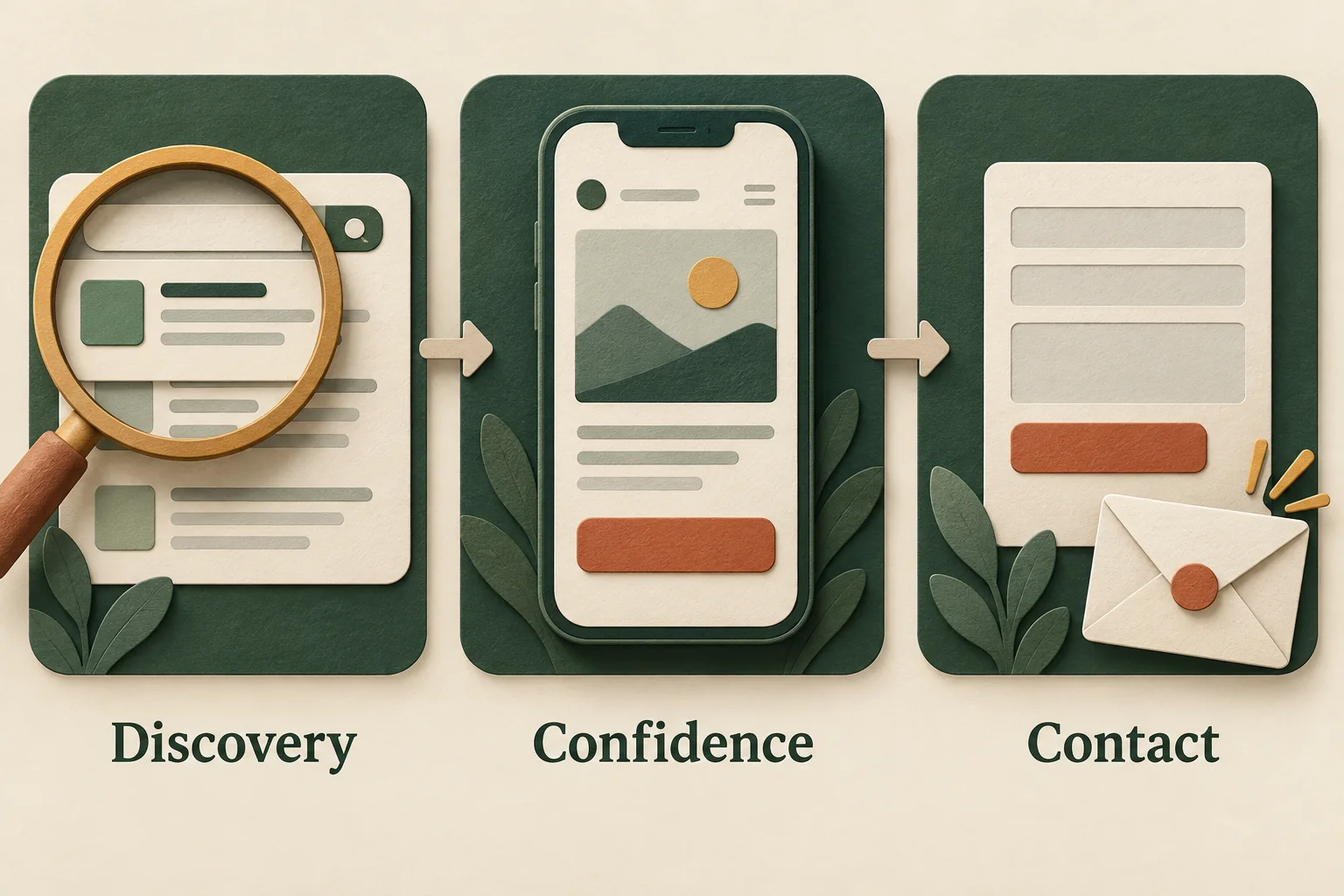
But lower traffic alone does not prove that your design is to blame. Start by separating three questions: Can people find you? Does the site give them confidence? Can they take the next step? Each question calls for different evidence—and sometimes a different fix.
For an established Southwest Florida business, the aim is to close the gap between the company customers experience in person and the company a new visitor sees online. You may need a clearer service page, current project photographs, or a working inquiry route before you need a complete rebuild.
Your website may be describing a business you have outgrown
A brand is partly an expectation. Your name, recommendations, vehicles, proposals, and conversations help customers form an idea of the quality and service they can expect. Your website either supports that expectation or makes them reconsider it.
Imagine a prospective customer receives a strong recommendation for a local renovation company. They visit the website and find a tiny gallery, a service description that emphasizes small repairs, and no explanation of how a larger project begins. The company may now handle substantial renovations well. The website still presents an earlier version of the business.
That is a fictional example, but it exposes a useful question: What would a stranger believe about your business if the website were their only evidence?
The mismatch can affect which prospects contact you, what work they request, and how much explanation your team must provide before a conversation becomes useful. You cannot measure those effects from the age of the site. You can investigate them through actual customer questions and the content those customers encounter.
The brand damage comes from doubt, not the calendar
An older website can remain clear, accurate, and useful. A new website can be confusing. Evaluate the experience rather than treating a launch date as an expiration date.
These are three ways an established site can start misrepresenting the business.
It makes your current standard of work difficult to see
Small, poorly organized photographs can hide workmanship. Generic descriptions can flatten the difference between a specialist and a general provider. An old list of services can give customers the wrong idea about the projects you now take on.
Show the work that supports your present offer. Use photographs you have permission to publish, explain the relevant project, and state your actual contribution. A visitor should not need to infer everything from an unlabeled gallery. Our selected work illustrates how project descriptions can separate website, brand, and ongoing marketing contributions.
It sends conflicting signals about who you are
A polished proposal paired with an inconsistent website creates an avoidable question: which version represents the company today? Different logos, competing messages, and obsolete contact information make that question harder to resolve.
Stanford's web credibility guidelines connect appropriate visual design, usability, and verifiable information with credibility. This is foundational research from 2002, not a current conversion benchmark or a promise about your customers. The practical lesson is to make the presentation fit the business and support it with evidence.
Consistency does not require every page to look identical. It requires the company name, offer, tone, visual identity, and contact details to tell the same story.
It makes dealing with you feel harder than it is
A customer who cannot find the service area or understand a form may hesitate before contacting an otherwise responsive team. The website has introduced friction before the business gets a chance to help.
Try completing a real customer task on a phone. Can you find the right service, understand whether it fits, and see what happens after an inquiry? Check that form fields have clear labels; W3C's form-label guidance explains why labels matter for understanding and accessibility.
For a broader review of evidence and reassurance, use our website trust-signals guide. Here, the priority is the gap between your actual business and the impression your site creates.
Noticed lower traffic? Identify what actually declined
“Traffic is down” can mean fewer Google clicks, fewer measured website visits, or fewer inquiries. Those are different observations. Search Console reports Google Search activity; website analytics and your inquiry records describe other parts of the journey. Do not treat their totals as interchangeable.
Google's traffic-drop guidance recommends comparing similar periods and examining affected pages and queries. It identifies several possible causes, including technical problems, changing demand, seasonality, and ranking changes. That makes a traffic drop a reason to investigate, not a diagnosis of an outdated design.
Use the following as a starting framework, not a set of automatic conclusions:
| What changed? | What to investigate first | What it does not prove |
|---|---|---|
| Google impressions and clicks fell | Affected pages, query demand, indexing, and recent site changes | That visitors disliked the design |
| Impressions held steady but clicks fell | Query mix, position, search-result presentation, and competing results | That a new home-page layout will recover clicks |
| Measured visits fell but Search Console clicks did not | Analytics configuration, consent changes, and other traffic sources | That Google visibility collapsed |
| Visits held steady but useful inquiries fell | Service fit, forms, call routes, inquiry delivery, and follow-up | That you simply need more traffic |
Compare complete periods using consistent filters. For a business with seasonal demand, examine the corresponding period in the previous year when that history is available. Avoid drawing a major conclusion from a few visits or a single quiet week.
Keep a short change log: tracking changes, campaign pauses, removed services, changed URLs, and form updates. It helps distinguish an observable website defect from a change that merely happened at the same time. Our measurement guide explains how to connect visibility and customer actions without overstating the result.
Where website design and local SEO meet
Local search can introduce a customer to your company. The page they reach still has to explain why your business fits their situation.
Consider a homeowner looking for a service in Cape Coral or Fort Myers. After landing on your site, they may need to know whether you accept their type of project, serve their actual location, and provide an appropriate next step. A generic “we do it all” page leaves those decisions unresolved.
Useful local content answers operational questions. A service business might explain its real coverage, appointment process, project requirements, or how it coordinates with an owner who is away—only when those arrangements are actually offered. Repeating city names adds little without that substance. A company serving Southwest Florida also should not imply it has an office in every community it visits.
Google's local ranking guidance describes relevance, distance, and prominence as key factors and stresses accurate business information. A visual redesign does not change your distance from a searcher or guarantee a stronger Maps position.
Likewise, Google advises evaluating page experience broadly; strong usability or performance scores alone do not guarantee top rankings. Better design should help customers use the information. Relevant content and sound technical foundations still need attention.
Run a brand-expectation review before approving a redesign
Open the page a prospect is most likely to encounter first. That may be a service page rather than the home page. Place a current proposal, brochure, or other accurate business material beside it.
For each row below, record the exact mismatch and the evidence needed to correct it. Avoid a vague conclusion such as “make it more modern.”
| What customers should understand | Evidence to look for on the site | A useful correction |
|---|---|---|
| The kind of work you want to win | Specific service scope and suitable project examples | Replace an obsolete offer with a clear description of current work |
| The standard you deliver | Relevant images and an accurate explanation of your role | Give an approved project enough context to support the claim |
| Whether you can help them | Actual coverage, requirements, and limitations | Answer the fit question before asking for an inquiry |
| What happens after contact | A specific next step and realistic response expectations | Make the button, form, confirmation, and follow-up agree |
| That this is the same company they were referred to | Consistent identity and accurate business details | Align the website with the current, approved brand materials |
Then ask someone unfamiliar with the business to describe what you do and how they would contact you, using only the page. Listen for mistaken assumptions and places where they get stuck. This is a practical usability exercise, not a statistically representative study.
A useful review record has four fields: what the page currently suggests, what is true, the evidence available, and the person responsible for the correction. That turns a subjective design conversation into a set of decisions an owner and designer can act on.
Fix the mismatch at the right scale
Start with a targeted update when the site works well and the gap is specific: outdated service copy, missing project context, inconsistent imagery, or unclear contact instructions.
A Legacy Refresh may fit when useful content and recognizable branding remain, but the presentation and navigation need coordinated improvement. A custom website becomes more relevant when the business needs a different page system, a substantially different offer, or functions the current site cannot support well.
Repair a reproducible fault, such as an inquiry that never arrives, promptly. Investigate an unexplained traffic decline before treating a redesign as the remedy. Preserve useful pages and customer paths whichever scope you choose; our older-website refresh plan covers that execution work.
Once changes are made, assess the result against the problem you identified. Can visitors now understand the service? Does the inquiry arrive? Are requests better matched to the work you want? Record those outcomes alongside comparable traffic data. A more attractive screenshot is not sufficient evidence of business improvement.
Questions owners ask about an older website
Can an old website still rank well?
Yes. Its age alone is not a diagnosis. Assess its relevance, accuracy, usability, technical condition, and actual search performance. Keep useful content and functioning customer paths when making changes.
Will a redesign bring back lost traffic?
There is no guarantee. If a decline comes from a technical fault, changing demand, tracking, or a different search issue, the appropriate work may extend beyond design. Establish what changed before setting expectations.
How do I know whether this is a brand problem or an SEO problem?
Look at both the evidence before the visit and the experience after it. Search data helps investigate discovery. Reviewing the page with prospective-customer questions helps reveal confusing positioning or missing proof. Testing the contact process checks whether interested people can act. More than one problem can exist.
Do I need to replace my logo and domain too?
An outdated page layout does not automatically require either change. Preserve recognizable assets that still fit the business. Consider broader brand changes when the identity or positioning itself is the problem, and plan any URL changes deliberately.
Make your website represent the business you run today
Your website should help a new customer see the quality, relevance, and care that existing customers already understand. When it falls short, the next step is to identify the mismatch and choose the smallest scope that solves it properly.
Local Legacy Consulting helps established businesses assess an older site and plan a clearer customer experience. Bring your current website, the work you want more of, and any traffic or inquiry changes you have noticed.
Request a website and brand-experience review. We can help separate content and design improvements from issues that need deeper investigation.