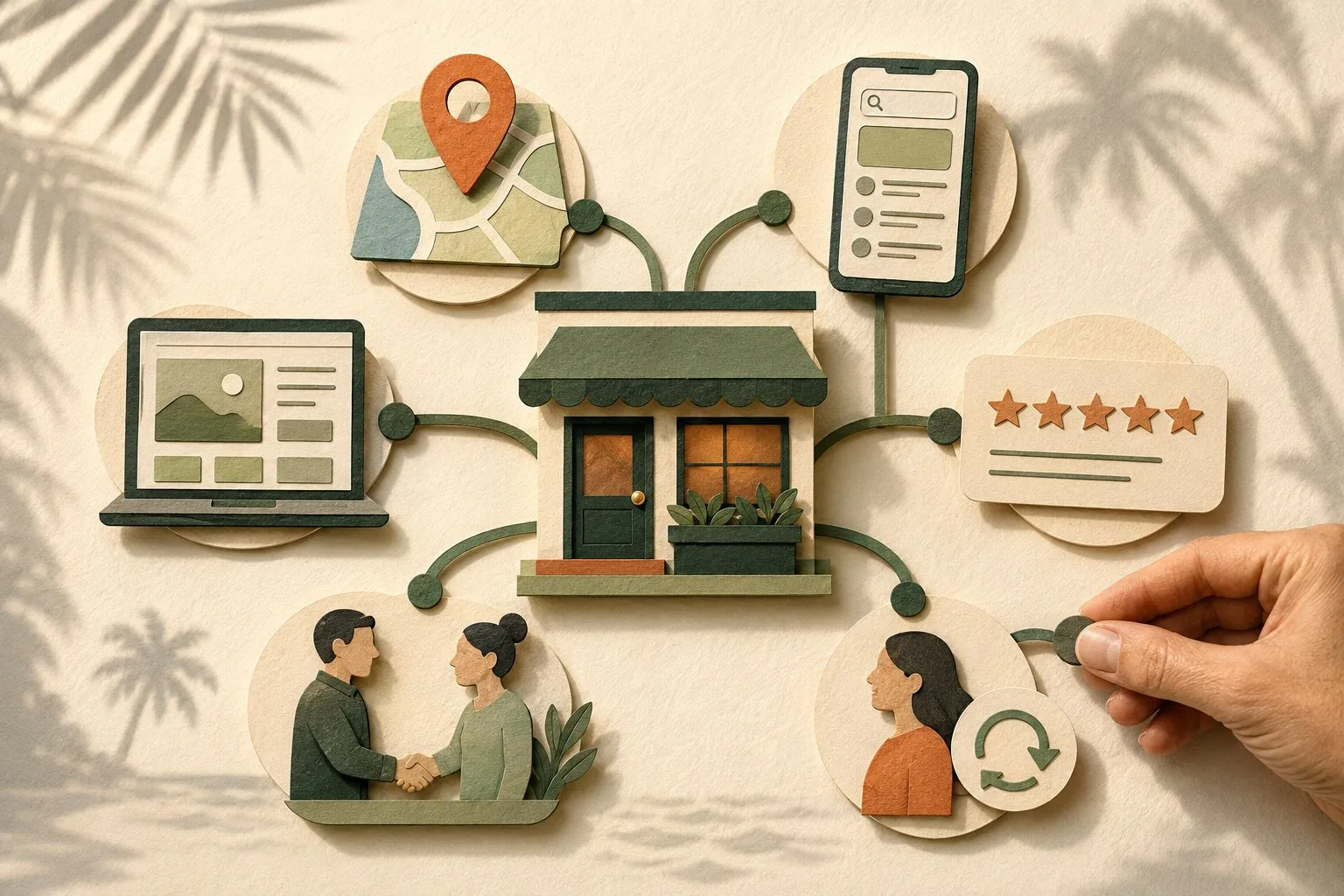
Getting more local customers rarely comes down to finding one secret channel. It comes from making a few connected decisions: whom you want to serve, which problem you solve, where those people look, what helps them trust you, and how you follow through after they raise a hand.
This guide gives small-business owners a practical way to build that system. It works for storefronts and service-area businesses, whether you rely on Google Search, Maps, referrals, community relationships, repeat business, or a mix of channels. The goal is not to be visible everywhere. It is to make the path from nearby need to useful customer action easier to find, understand, and complete.
Start with a specific customer job and service area
“Everyone nearby” is not a workable target market. A useful local marketing plan begins with one customer, one job, and one geographic boundary.
Write a short working statement:
We help [specific customer] in [real service area] handle [important job or problem] through [service or product], with [meaningful reason to choose us].
A Cape Coral pool company might focus on homeowners who need dependable weekly service within a route the team can actually support. A Fort Myers professional-services firm might focus on owner-led companies that need a clear project scope and direct access to the person doing the work. The point is not to make the audience artificially narrow. It is to stop marketing a vague promise to an undefined place.
The U.S. Small Business Administration recommends grounding a marketing plan in a defined target market, competitive advantage, sales plan, goals, action plan, and budget. Its current marketing and sales guide is a useful planning reference because it connects promotion to the business model instead of treating marketing as a list of isolated tactics.
Before choosing a channel, answer:
- Which service or product creates a healthy, deliverable customer relationship?
- What event causes someone to look for it now?
- How far can you serve profitably and reliably?
- What proof would a cautious buyer need?
- What action can your team respond to consistently?
If those answers are unclear, more traffic usually creates more confusion rather than more good-fit customers.
Build one clear path from need to next step
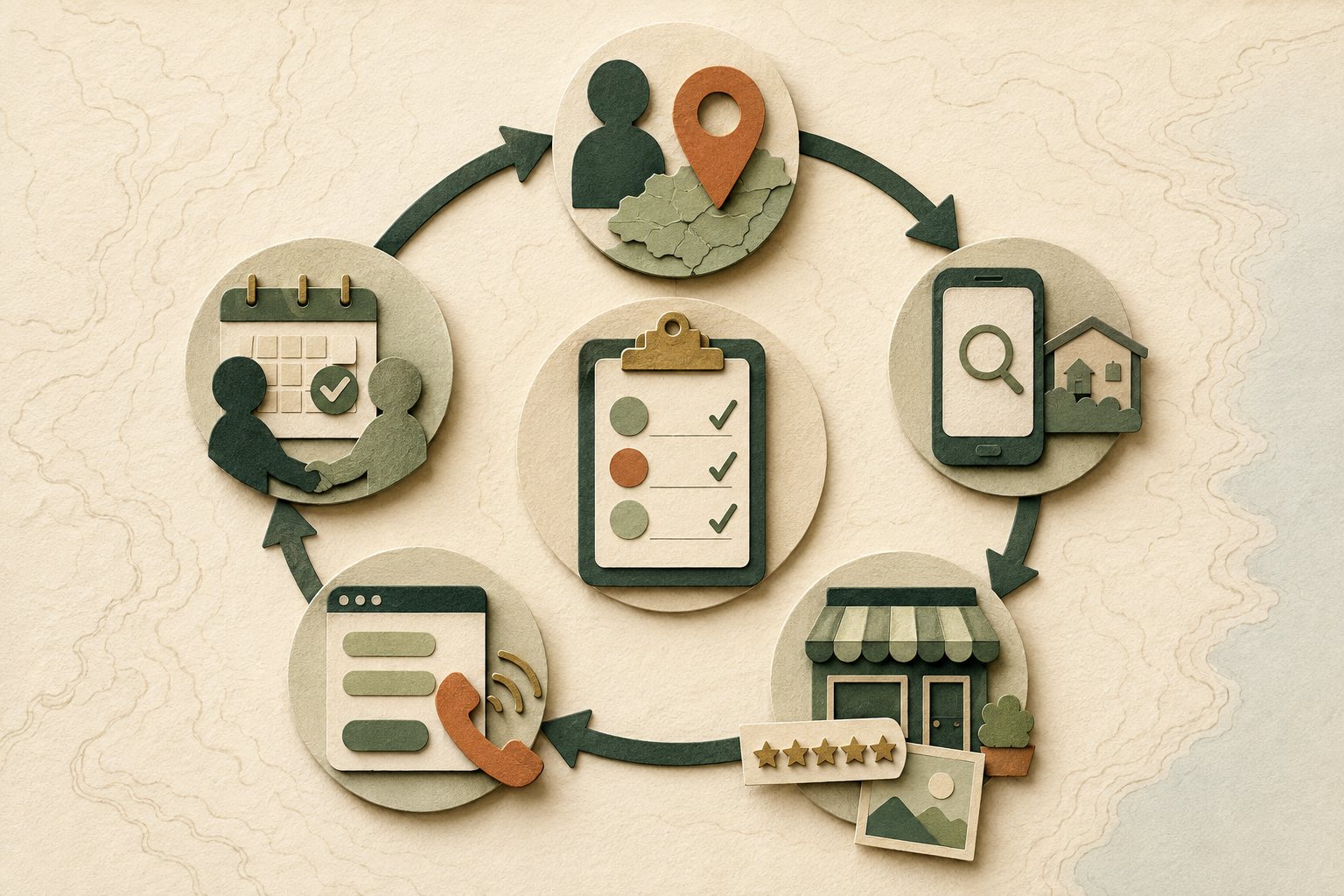
Local customers often move across several touchpoints. They may hear a name from a neighbor, check the Google Business Profile, scan reviews, visit the website on a phone, and call two days later. Treat those touchpoints as one journey.
Map a simple path:
| Stage | Customer question | What your business should provide |
|---|---|---|
| Need | “Can someone handle this?” | A specific service, product, or solution |
| Discover | “Who serves my area?” | Accurate profile, useful page, sign, referral, or local mention |
| Evaluate | “Can I trust this business?” | Real proof, clear scope, current information, and expectations |
| Act | “What do I do next?” | One appropriate call, form, booking, visit, or purchase path |
| Continue | “What happens now?” | Prompt confirmation, useful follow-up, and a named owner |
| Return or refer | “Would I use or recommend them again?” | Reliable delivery, a respectful review request, and an easy re-entry path |
Choose one primary action for the service you are promoting. “Request an estimate,” “Book a consultation,” “Call for same-day availability,” and “Visit the showroom” describe different commitments. Use the action that matches how the business actually sells and fulfills the work.
Then complete the action yourself on a phone. Check the link, form, confirmation, notification, calendar, and staff handoff. A marketing campaign is not ready if the final step disappears into an unmonitored inbox.
Choose channels by customer intent
The best channel is the one that matches how a particular customer recognizes and acts on a need. Use fewer channels well before adding more accounts, campaigns, or subscriptions.
| Customer situation | Useful channels | First improvement to make |
|---|---|---|
| Needs help now | Google Search, Maps, call, service page | Make service, area, hours, and contact path accurate |
| Needs to compare options | Website, reviews, project proof, proposal | Explain scope, fit, proof, and next step |
| Does not know the solution yet | Helpful guide, local event, email, social education | Answer the question that comes before the sale |
| Relies on trusted recommendations | Referrals, professional partners, neighborhood networks | Give partners a clear description and destination |
| Already knows the business | Email, reminders, account follow-up, seasonal service | Make rebooking or repurchasing easy |
This prevents a common small-business marketing mistake: expecting every channel to create demand, explain the offer, overcome risk, capture the inquiry, and close the sale by itself.
Social media may help people recognize the team and see current work. A service page can answer detailed questions. Maps can connect immediate local intent to a call or visit. A referral can transfer trust. Give each channel a clear job, then connect it to the next useful destination.
Strengthen local discovery without chasing shortcuts
For many local businesses, discovery begins in Google Search or Maps. Start with accurate business information, not keyword decoration.
Google says local results are mainly based on relevance, distance, and prominence. Its local ranking guidance recommends verifying the Business Profile, keeping information complete and accurate, updating hours, choosing an appropriate category, responding to reviews, and adding photos and videos. Google also states that there is no way to request or pay for better local ranking.
Use that guidance as an operating checklist:
- Keep the real business name, primary category, phone, website, hours, address or service area, and services current.
- Use original photos that help a customer understand the people, place, process, products, or finished work.
- Link the profile to a page that supports the same service and customer action.
- Maintain distinct, useful service and location information on the website.
- Correct duplicate, outdated, or misleading information carefully.
- Give each profile task a real owner and review date.
Do not create false offices, stuff city names into the business name, or publish nearly identical location pages. A Fort Myers, Cape Coral, or broader Southwest Florida business should describe where and how it really operates. The service-area page guide explains how to build regional and city paths without thin doorway content.
If the local search foundation needs structured work, follow the 90-day local SEO plan for Southwest Florida service businesses rather than turning this broader customer plan into another SEO checklist.
Make the website answer the decision behind the click
A website does not need to say everything at once. It does need to help the right visitor answer a few important questions:
- Am I in the right place for this service or product?
- Does this business serve my location or situation?
- What is included, and what is not?
- What real evidence supports the claims?
- What should I expect after I contact or buy?
- What is the safest, easiest next step?
Create or improve the page closest to the customer’s need. Use a descriptive heading, plain-language scope, relevant proof, useful local context, common questions, and one primary action. Do not send every search, ad, profile, and partner link to a generic homepage when a more specific destination exists.
Keep forms short enough for the stage of the relationship. The W3C’s accessible forms tutorial recommends clear labels, instructions, and feedback, and notes that people generally prefer simple forms that request only what is needed to complete the process. Confirm successful submission and explain what happens next.
Use the website trust signals guide to audit proof, identity, policies, and safer customer actions. For the words and destinations attached to buttons, use these website call to action examples.
Turn good work into reviews and referrals
Reviews and referrals are not substitutes for good service. They are ways satisfied customers can make that service easier for someone else to evaluate.
Build a simple, fair request process:
- Identify a natural completion or follow-up moment.
- Ask every eligible customer using the same neutral standard.
- Make the review or referral path easy to open.
- Do not write the customer’s opinion for them.
- Respond professionally and protect private information.
- Record recurring praise and complaints as operating feedback.
Google’s review guidance says reviews should reflect genuine experiences and prohibits incentives such as free or discounted goods or services in exchange for posting, changing, or removing reviews. The Federal Trade Commission’s consumer reviews and testimonials rule Q&A also prohibits incentives conditioned on a particular sentiment and addresses disclosure and insider relationships. Platform rules can be stricter than the legal baseline, so follow the rules of every place where you request or display feedback.
For referrals, do not say only, “Send people our way.” Give customers and partners a short, accurate description of who is a good fit, what problem you handle, where you work, and where to learn more. A clear referral is easier to remember and less likely to create a poor-fit introduction.
Build local relationships that help customers
Local partnerships work when they create genuine usefulness, not a disguised link exchange.
Look for businesses, associations, venues, nonprofits, suppliers, and professionals that serve the same people at a different point in the journey. A home-service company may have useful relationships with property managers, inspectors, real-estate professionals, or complementary trades. A retailer may collaborate with nearby makers, events, and community organizations. A business-to-business provider may contribute a practical workshop or checklist to an association its audience already trusts.
Evaluate a potential partnership with five questions:
- Do we serve an overlapping audience without creating a conflict?
- Can we explain the mutual customer benefit in one sentence?
- Are responsibilities, permissions, costs, and follow-up clear?
- Would the activity still be worthwhile if it produced no search-ranking benefit?
- Can both businesses represent the relationship truthfully?
Useful collaboration might include a co-hosted educational event, a responsible referral arrangement, a shared customer resource, a locally relevant project, or a real supplier or membership credit. Avoid mass directory submissions, fabricated sponsorships, paid “best of” badges, and reciprocal links with no customer purpose.
Follow up before buying more attention
More discovery does not help if inquiries sit unanswered. Define the handoff from marketing to operations.
For each inquiry type, document:
- where the notification goes;
- who owns the first response;
- what information must be confirmed;
- when a second contact is appropriate;
- how no-response, not-ready, and poor-fit inquiries are handled; and
- how the source and eventual outcome are recorded.
Use confirmation messages to set expectations rather than make promises the team cannot keep. If response time varies, state the normal business-hours process instead of claiming “instant” service. Preserve consent and give people a clear way to stop nonessential messages.
Then inspect the customers you already have. Maintenance reminders, seasonal preparation, replenishment, follow-up care, warranty information, and useful education can make it easier for a past customer to return. Retention deserves its own service standard; it should not become relentless promotion.
Track qualified outcomes by source
Do not judge a channel only by impressions, followers, or visits. Track enough information to decide what to improve.
Start with a small lead record:
| Field | What to capture |
|---|---|
| Date | When the inquiry arrived |
| Source | Search, Maps, referral, partner, event, social, email, ad, direct, or unknown |
| Service or product | What the person actually wanted |
| Area | City, ZIP code, or service area when relevant and appropriate |
| Fit | Qualified, uncertain, poor fit, or existing customer |
| Next step | Called back, estimate, visit, booked, purchased, follow-up, or closed |
| Outcome | Record only what the team can verify |
Ask “How did you hear about us?” when it is natural, but do not assume the answer identifies the entire journey. A customer may say “Google” after first hearing the name from a neighbor.
Business Profile performance can report interactions such as calls, website clicks, and direction requests. Google explains those definitions and limitations in its Business Profile performance guide. Treat those interactions as signals, then compare them with qualified inquiries and outcomes the business can verify.
Once a month, review the chain:
- Visibility: Did the intended audience encounter the business?
- Action: Did people call, click, visit, book, or submit?
- Quality: Were the inquiries relevant and serviceable?
- Outcome: What happened next?
- Work completed: What changed during the same period?
- Decision: What is the one next improvement?
The local SEO measurement scorecard provides a deeper reporting framework for Search Console, Business Profile, website actions, lead quality, and completed work.
Use this 30-day local customer plan
Keep the first month focused enough to finish.
Week 1: define the offer and path
- Choose one priority customer, service or product, real service area, and primary action.
- Map the journey from discovery through follow-up.
- Test the call, form, booking, visit, or purchase path on a phone.
- Create a basic lead-source and outcome record.
Week 2: repair local discovery
- Audit the Business Profile and important listings for accurate information.
- Improve the most relevant service or product page.
- Add current, permissioned photos and proof.
- Remove or correct outdated offers, hours, locations, and links.
Week 3: activate proof and relationships
- Start a neutral review request at the right customer moment.
- Give staff a clear referral description and destination.
- Contact two genuinely complementary local partners with one useful idea.
- Publish or improve one answer to a real customer question.
Week 4: strengthen follow-up and decide
- Review response ownership and confirmation messages.
- Reconnect with appropriate past customers through a useful service reminder or update.
- Compare sources, actions, qualified inquiries, and outcomes.
- Keep what produced a useful signal; repair or pause what did not work; choose the next 30-day focus.
This is not a promise that a channel will produce customers within 30 days. It is a way to replace scattered activity with a complete operating loop and enough evidence for the next decision.
Adjust the plan for Southwest Florida
Southwest Florida businesses often serve a mix of year-round residents, seasonal residents, property owners, visitors, and other businesses. The mix differs by industry, so do not assume every city, season, or customer behaves the same way.
Use local context only when it changes the customer decision or the way the work is delivered:
- State the real service boundary and travel limitations.
- Keep hurricane, holiday, and seasonal hours current across the website and profiles.
- Explain appointment, access, lead-time, or property-presence requirements when they matter.
- Route Fort Myers, Cape Coral, Port Charlotte, and regional visitors to genuinely useful information instead of copied city pages.
- Make phone actions, directions, forms, and proof easy to use on a mobile device.
Explore Local Legacy Consulting’s Southwest Florida digital services, Fort Myers service approach, and Cape Coral service approach for the regional and city pathways already established on this site.
Frequently asked questions
How can a small business attract more local customers?
Define a specific customer, problem, service area, and next step. Then connect the places people discover the business—such as Maps, Search, referrals, local partnerships, signs, and social content—to clear proof, an appropriate action, prompt follow-up, and source tracking.
What should I fix first: my Google Business Profile or my website?
Fix any inaccurate public information first. Then repair the weakest part of the customer path. If the profile is incomplete, update it. If the profile sends people to a vague or broken website page, fix that destination. The two should support the same real service and next step.
How do I get more local customers without paying for ads?
Improve accurate local profiles, useful service pages, genuine reviews, referrals, partner relationships, customer follow-up, and repeat-business reminders. These approaches still require time and operational attention, and none guarantees demand, but they can improve the customer path without media spending.
Should I use every social media platform?
No. Choose channels that your customers actually use and that your team can maintain. A complete, current profile with a useful destination is better than several abandoned accounts. Give each channel a defined role in discovery, evaluation, or follow-up.
How do I know which local marketing channel works?
Track the source, requested service, fit, next step, and verified outcome for inquiries. Compare that record with profile, website, email, event, or campaign data. Use source information as evidence, not perfect attribution, because customers often encounter several touchpoints.
How long does it take to get more local customers?
There is no universal timeline. It depends on existing awareness, demand, competition, reputation, service area, price, capacity, sales process, seasonality, and the channel used. Set a dated baseline, review leading and qualified outcomes regularly, and improve one bottleneck at a time.
Make the whole path easier to choose
The practical answer to how to get more local customers is not “post more” or “rank first.” It is to make a good-fit local customer easier to recognize, reach, reassure, help, and remember—and to make the next step work when that person is ready.
Local Legacy Consulting helps small and local businesses connect brand clarity, website design, local visibility, social presence, and customer follow-up into one useful system. Explore local visibility support, review small-business website design, or start a conversation about your customer path.