
Most local SEO problems are not caused by one missing keyword. They come from a mismatch: the Google Business Profile says one thing, the website says another, the location pages add no useful detail, or the business measures visibility without checking whether people call, book, or submit a form.
This guide covers ten SEO mistakes small businesses make, how to spot each one, and what to fix first. It is written for owner-led service businesses, including companies serving Fort Myers, Cape Coral, and the wider Southwest Florida market. The same diagnostic process applies elsewhere without pretending every city or industry behaves identically.
1. Starting with rankings instead of a customer action
“Rank higher” is not a complete goal. A local SEO plan needs to connect a search to an action the business can recognize: a qualified phone call, estimate request, appointment, store visit, or purchase.
Without that connection, a business may attract irrelevant traffic or celebrate impressions that never become conversations. Before changing a page, write down:
- the service or product that matters;
- the customer and real service area;
- the page that best answers that need;
- the primary next action; and
- the system that records the action.
For a structured implementation sequence, use the 90-day local SEO plan for Southwest Florida service businesses.
2. Leaving the Google Business Profile incomplete or inaccurate
The Business Profile should reflect how the company operates in the real world. Common errors include an outdated category, inconsistent hours, an old phone number, a broken website link, services that are no longer offered, and an address displayed for a service-area business that does not receive customers there.
Google says local results are mainly based on relevance, distance, and prominence, and recommends complete, accurate profile information. It also says there is no way to request or pay for better local ranking. See Google’s local ranking guidance and business representation rules.
Fix first: compare the live profile with the website, phone routing, current hours, services, and real operating model. Correct factual conflicts before writing more content. Then use the Google Business Profile optimization guide for a complete review.
3. Treating a service area like a collection of extra offices
Adding Fort Myers, Cape Coral, or another city to a service area does not create a new physical location. A website page also does not create eligibility for another Business Profile.
For a business that travels to customers, describe the coverage truthfully and hide the address when customers are not served there. Google’s service-area instructions explain that areas are set by city, postal code, or another defined area rather than a radius.
Fix first: label real offices as locations and travel coverage as service areas. Remove wording that implies a storefront, branch, or local team that does not exist.
4. Publishing a thin page for every city and service combination
One of the most expensive local SEO mistakes is creating dozens of near-duplicate pages by swapping city names. These pages are hard to maintain, confusing to customers, and vulnerable to overlap.
Google defines doorway abuse as pages created to rank for similar queries while funneling people toward the same destination. Its examples include substantially similar pages targeted to regions or cities. Review the current Google Search spam policies before approving a location-page rollout.
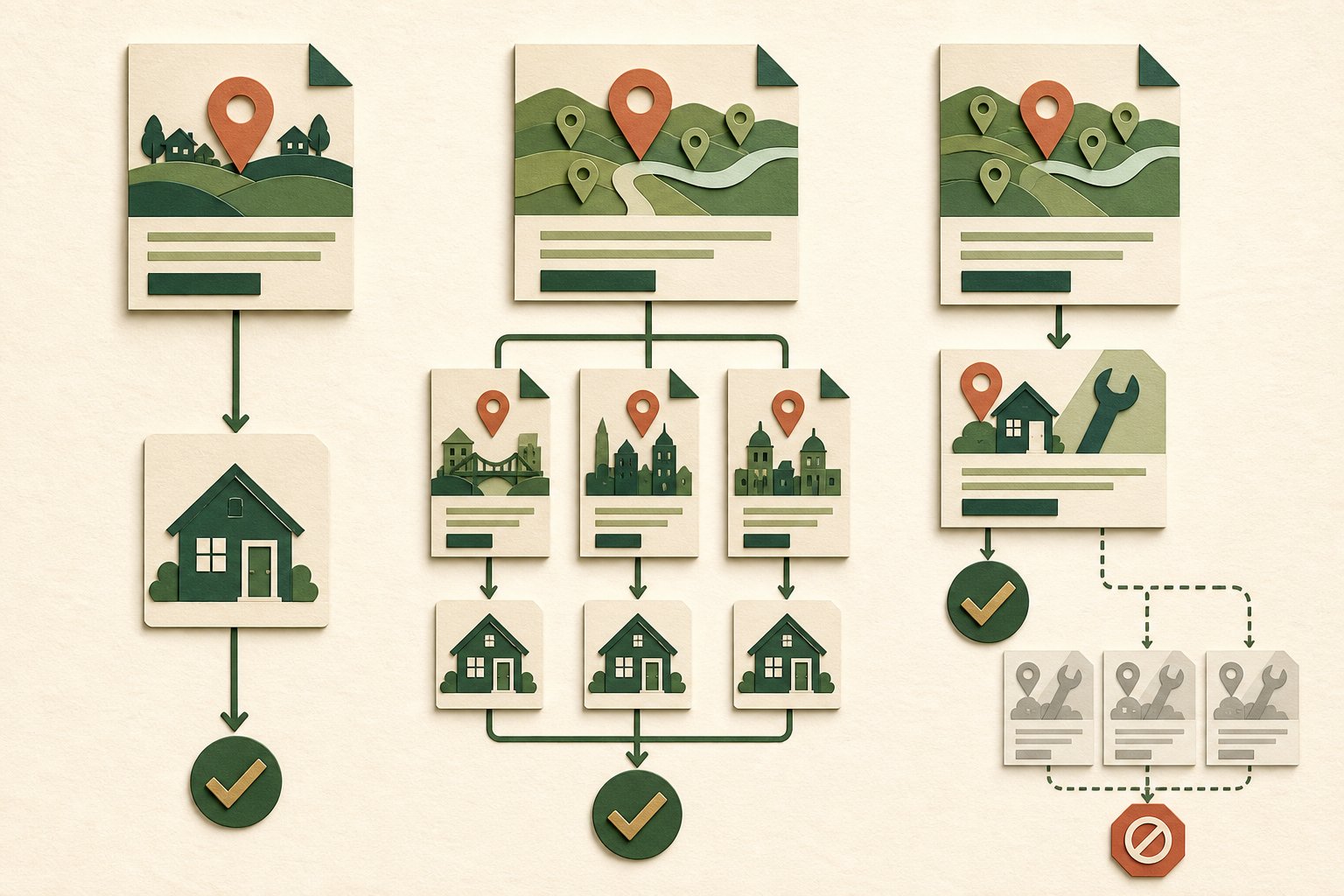
A regional hub or a few substantive city pages can form a clear path. Multiplying one service across many weak city pages creates maintenance, overlap, and doorway-page risk.
Use a separate city page only when it can add information a customer in that place would value, such as verified work, distinct logistics, service availability, local questions, or a different buying concern. The service-area page planning guide includes a decision framework and launch checklist.
5. Making every page target the same broad phrase
The homepage, service page, city page, and article should have different jobs. When every title, heading, and internal link targets the same phrase, the site creates unclear choices for both visitors and search engines.
A simple intent map helps:
| Page type | Primary job | Useful next link |
|---|---|---|
| Service page | Explain the offer, fit, process, and next step | Relevant city pages and proof |
| City page | Explain truthful local coverage and differences | Canonical services and local evidence |
| Article | Answer a specific planning or how-to question | The service that solves the larger problem |
| Contact page | Make the inquiry clear and low-friction | Confirmation and next-step expectations |
Fix first: assign one primary intent to each important URL. Merge or redirect pages that cannot earn a distinct purpose. Do not use a canonical tag as a substitute for a useful page.
6. Writing generic claims without local or first-party evidence
“Trusted,” “best,” and “serving the whole area” do not prove anything on their own. Useful evidence can include a named project with permission, an accurate scope, original photos, a real process, service limitations, professional credentials, or a clearly attributed review.
Google’s people-first content guidance asks whether content provides original information, demonstrates first-hand expertise, and leaves the reader able to accomplish a goal. That is a better standard than adding more city names.
Fix first: choose the three strongest claims on the page and place specific evidence near each one. If the evidence is unavailable, narrow the claim. The website trust signals guide shows how to connect a claim, its evidence, and the customer action.
7. Using review shortcuts that create policy risk
Reviews matter, but the request must be honest. Buying reviews, offering discounts for reviews, asking only happy customers, or telling customers what to write can distort the record and violate platform rules.
Google’s Maps policy says reviews should reflect genuine experiences. It prohibits paid or incentivized reviews, selective positive-review solicitation, and requests that pressure customers to include specific content. See the current fake-engagement and rating-manipulation policy.
Fix first: ask real customers consistently, without an incentive or required rating. Make the request easy, respond professionally, and use feedback to improve the actual service.
8. Hiding important pages behind weak internal links
A page may be technically live but difficult to discover if it is linked only from a sitemap, a long footer, or an unlabeled “learn more” button.
Google recommends crawlable links and descriptive anchor text that helps people and search engines understand the destination. Its link best practices also say every important page should have a link from at least one other page on the site.
Fix first: link from the regional hub to the strongest city pages, from each city page to relevant services, and from useful articles to the commercial page that solves the broader problem. Local Legacy Consulting’s Southwest Florida hub, Fort Myers page, Cape Coral page, and Local Visibility service demonstrate those distinct roles.
9. Ignoring the mobile path from search to contact
Local searches often lead directly to a phone call, directions request, form, or booking step. A page can be relevant and still lose the opportunity if the phone number is hard to tap, the form is fragile, the call to action is vague, or the page shifts while loading.
Google uses the mobile version of content for indexing and ranking and strongly recommends a mobile-friendly site. Its mobile-first indexing guidance recommends responsive design as the easiest pattern to implement and maintain. Google also defines Core Web Vitals around loading, responsiveness, and visual stability.
Fix first: test the important page on a real phone. Tap the phone number, submit the form, check the confirmation, and confirm the lead reaches the right person. If the site structure or mobile path needs deeper work, compare Website Kits and The Legacy Refresh.
10. Measuring positions but not leads or customer quality
Rankings vary by location, device, history, and query. A single screenshot cannot show whether local SEO is helping the business.
Google explains that Search Console reports impressions, clicks, pages, and queries before a person reaches the site, while Analytics reports what people do afterward. Used together, they can connect organic traffic with actions such as purchases or lead-form submissions. See Google’s guide to using Search Console and Analytics data for SEO.
Fix first: review a small scorecard monthly:
- qualified calls, forms, bookings, or sales from organic search;
- the landing pages that produced those actions;
- Search Console clicks and impressions for the relevant pages and queries;
- Business Profile actions when available;
- lead quality, not only lead volume; and
- factual problems discovered during the review.
What should a small business fix first?
Do not try to repair all ten problems at once. Use this order:
- Correct false, outdated, or policy-risk information.
- Confirm calls, forms, bookings, and tracking work on mobile.
- Choose the primary customer action and page for each priority service.
- Consolidate thin or overlapping pages.
- Add honest proof and descriptive internal links.
- Improve reviews, content, and authority as ongoing operations.
- Review results monthly and adjust from real evidence.
That order protects customers first, then creates a clearer foundation for visibility and growth.
Frequently asked questions
What is the most common local SEO mistake for a small business?
The most damaging pattern is inconsistency: the profile, website, location claims, services, and customer actions do not tell the same accurate story. Correct factual conflicts before pursuing more keywords or pages.
Do I need a page for every city I serve?
No. Start with clear regional coverage. Add a city page only when it can answer a distinct customer need with verified local detail, proof, or operating information.
Can changing my Google Business Profile service area make me rank higher?
Service areas should describe where the business genuinely operates; they are not a guaranteed ranking lever. Google says local results are mainly based on relevance, distance, and prominence. Keep the information accurate and focus on the complete customer experience.
How long does it take to fix local SEO mistakes?
Factual corrections and broken contact paths can often be handled quickly, while consolidating pages, earning reviews, building proof, and evaluating results take ongoing work. Avoid universal timelines or ranking guarantees.
Should I delete a weak location page?
First check its traffic, links, conversions, and useful content. If the page cannot support a distinct purpose, merge its useful material into the best hub or service page and redirect the old URL. If the purpose is valid, improve it with accurate local evidence.
Build one accurate system, not a pile of tactics
Strong local SEO is easier to manage when the Business Profile, website, proof, reviews, internal links, mobile actions, and measurement agree. Fix the inaccurate and fragile parts first. Then invest in the pages and evidence that help real customers make a decision.
Local Legacy Consulting helps Southwest Florida businesses turn those pieces into a practical visibility system without invented claims or vague ranking promises. Explore Local Visibility or start a conversation.